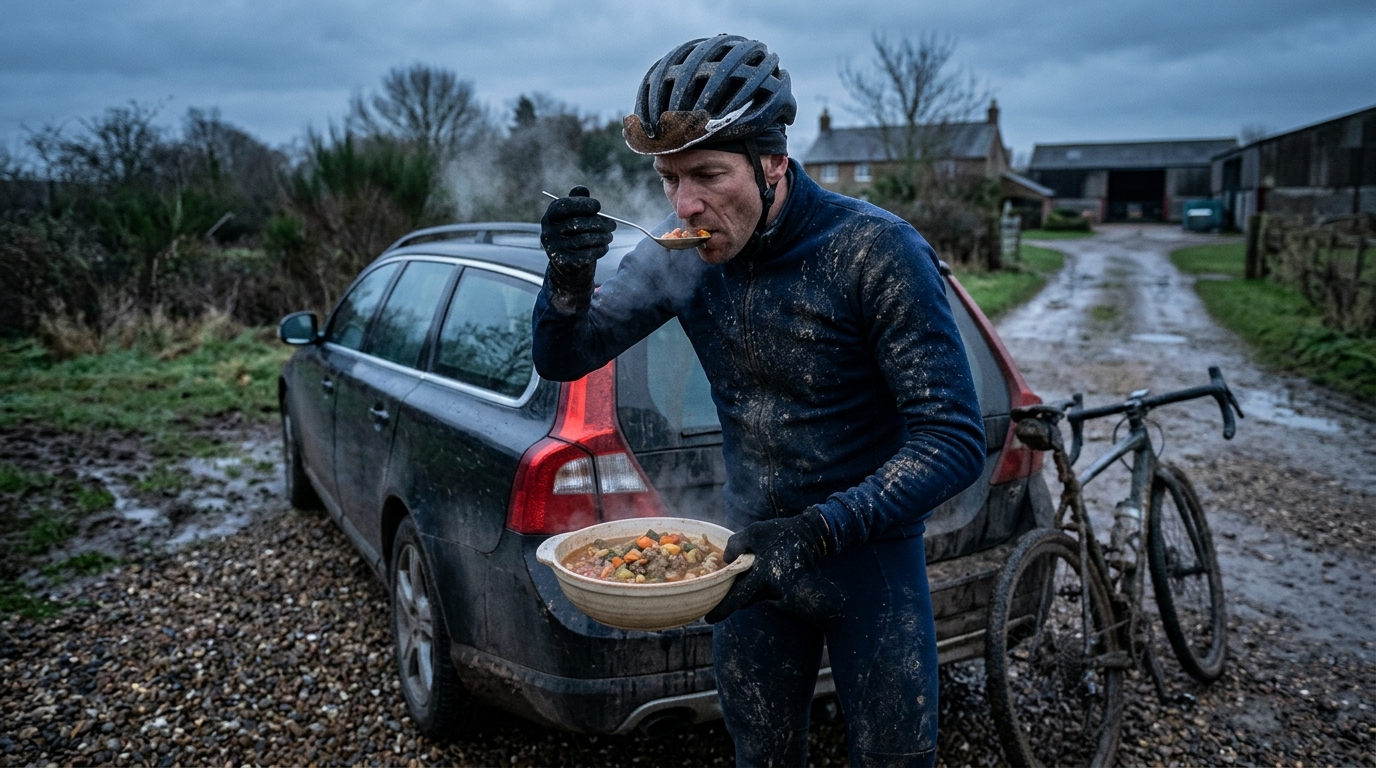
Image generated by our model.
race strategy
Cycling Race Category Upgrade: Know When You Are Ready
Use results, power data, repeatability, and race craft to decide when a cycling race category upgrade is earned rather than rushed.
What Cycling Race Categories Actually Measure
A cycling race category upgrade is often treated like a badge of fitness, but categories are not a clean ranking of aerobic ability. They are a sorting tool. They try to group riders who can handle similar race speeds, tactical complexity, pack pressure, and decision-making load.
That distinction matters. A rider can have strong lab-style numbers and still be unready for a harder field if they burn matches at the wrong time, drift backward before decisive moments, or panic when the race compresses through corners. Another rider can have less impressive steady-state power but race efficiently enough to survive, position, and finish where it matters.
Categories measure outcomes, but the outcomes are produced by physiology, skill, risk management, and judgment. The upgrade question is not simply, 'Am I strong enough?' It is, 'Can I repeatedly create or follow race-winning situations without relying on luck, perfect conditions, or a course that hides my weaknesses?'
That is the right frame for data-driven athletes. The goal is not to chase the move because a file looked good. The goal is to know whether your current strengths transfer when the racing gets faster, tighter, and less forgiving.
Why Results Alone Do Not Tell the Full Story
Results matter because racing is not a fitness test. If you cannot convert power into position, selection, or a finish, the file is incomplete. But results by themselves can mislead.
A podium from a small or passive field may say less than a hard mid-pack finish in a stacked race. A win from a breakaway on a course that perfectly suits you may not predict how you will handle a faster, more chaotic field. A placing earned from sitting in all day and sprinting against tired riders can be real, but it may not reveal whether you can survive a higher-category race where the decisive pressure arrives earlier and more often.
This is where power data becomes useful. Not because it replaces results, but because it explains how the result happened.
Ask better questions after every race:
- Did you make the front group because you were strong, or because the race never forced a real selection?
- Did you finish well after spending little energy, or after responding to repeated attacks and still having a finish?
- Did you control your position before key sections, or were you rescued by the race slowing down?
- Did your best result come from a narrow scenario, or from a repeatable pattern?
Upgrade systems often reward outcomes, and that is reasonable. But your decision should include the process behind those outcomes. If your results are improving while your files show lower cost, better timing, and more controlled efforts, that is a strong signal. If your results depend on desperate spikes, missed moves, and late recoveries, the headline may be ahead of the substance.
Power Benchmarks That Actually Matter
There is no universal power number that says you are ready. The trap is thinking a threshold value or peak power automatically maps onto amateur race levels. Racing is too course-specific and too tactical for that.
The better benchmark is whether your power profile matches the demands that decide your races.
Start with threshold and aerobic durability. FTP is still important because it shapes how costly every surge feels. A rider with a stronger sustainable base can absorb repeated accelerations with less damage. But threshold alone rarely settles the upgrade question. Plenty of riders have respectable steady power and still get shelled when the race becomes stochastic.
Look at your ability to produce hard efforts after fatigue. In lower categories, many decisive moves happen because the field hesitates or lacks cohesion. In harder races, selections often come after the race has already been hard. If your short power only looks good when fresh, your file may flatter you. If you can still accelerate meaningfully after repeated surges, long periods of tension, and limited recovery, that is much more predictive.
Also examine how much power it costs you to stay in position. Two riders can sit in the same group with very different files. The efficient rider moves before the pinch point, coasts when possible, and avoids unnecessary braking. The inefficient rider surges out of every corner, closes gaps late, and rides in the wind at the wrong moments. Same pack, different physiological race.
The strongest sign is not a single standout number. It is a file where your decisive efforts are intentional, your recovery between efforts is stable, and your final contribution is not an accident.
How to Compare Your Race Files to Higher Categories
The most useful comparison is not between your best power and someone else’s best power. It is between your race pattern and the pattern required when the field is stronger.
Use your files to build a simple audit.
Compare the shape of the effort
Look beyond average power. A comfortable average can hide repeated spikes that are slowly draining you. A high average can also be manageable if the effort is smooth and predictable. What matters is the rhythm.
Review where the race was actually hard:
- Before corners or narrow sections
- On rises or exposed roads
- During attacks and counterattacks
- In the run-in to the finish
- When riders fought for position before decisive terrain
Then ask whether you were choosing those efforts or reacting late. The next category tends to punish reaction time. If you are constantly closing gaps after they open, you are not just spending more energy. You are giving the race control over your physiology.
Compare your cost of positioning
Position is power savings before it is tactics. If you can hold a useful place near the front without burning repeated matches, you are probably closer to being ready than a rider who produces bigger peaks from the back.
In your file, look for unnecessary surges after coasting or braking. Those are often signs of poor anticipation. The power meter records them as watts, but the race explanation is usually positioning.
Compare your final availability
The upgrade question often comes down to what you can do when the race is already selective. If your final effort is strong only when the race has been passive, you have a limited skill set. If you can still sprint, bridge, or contribute after a genuinely hard race, that carries forward.
This is where an FTP estimator can help establish a baseline, but the race file should remain the primary evidence. Estimators are useful for calibration. Upgrade decisions require context.
Skills and Repeatability That Matter
The higher the category, the less forgiving the race becomes. Fitness still matters, but the ability to repeat hard actions cleanly starts to separate riders who are merely strong from riders who are ready.
Repeatability under pressure
A single acceleration is not enough. Racing asks for effort, partial recovery, another effort, then a decision while breathing hard. Track whether your major efforts in a race remain purposeful. If every response gets weaker and more chaotic, the limiter is not only power. It is repeatability and pacing discipline.
Pack efficiency
Efficient riders make fewer costly corrections. They hold wheels smoothly, avoid overlapping panic, and move before the field compresses. This shows up as fewer violent spikes for the same position. If your file is jagged while the race was not especially selective, you are leaking energy through technique.
Timing
Strong riders still lose races by spending power at low-value moments. Riders who are ready to move up understand when an effort changes the race and when it only relieves anxiety. If you are attacking when the field is fresh, chasing every move, or moving up only after the road narrows, you are paying premium energy for low control.
Recovery while racing
Recovery is not just what happens after the race. It happens inside the race. Can you reduce power while staying protected? Can you eat or drink without losing position? Can you let a teammate or another motivated rider close a gap instead of volunteering for every problem?
Those are performance skills. They turn fitness into repeatability.
Red Flags That You Are Moving Up Too Early
An early upgrade is not always a disaster, but it can slow development if it puts you into races where you only survive. Survival has value for a while. It teaches speed, positioning, and humility. But if every event becomes a defensive exercise, you may stop practicing how to win.
Watch for these red flags before forcing the move:
- Your best results come from races with unusually passive fields
- You regularly finish well but cannot explain how you conserved energy
- Your race files show repeated panic spikes from poor positioning
- You lose contact before decisive moments rather than during them
- You can produce strong power fresh but not after fatigue
- You avoid technical or fast courses because they expose handling gaps
- You rely on one narrow tactic, such as a late sprint or early move
The biggest warning sign is lack of control. If your races feel like things are happening to you rather than because of you, upgrading will magnify that problem. Higher categories do not usually give riders more time to think. They make the same decisions arrive faster and with higher cost.
That does not mean you need to dominate before moving up. Waiting until you are never uncomfortable can become its own trap. But you should be able to influence races at your current level in more than one way. You should know how to follow, conserve, position, and finish. You should be able to identify mistakes in your file without needing the result sheet to tell you whether the day was good.
Build a Data-Backed Upgrade Plan
A good upgrade plan starts with evidence, not emotion. The point is to create a repeatable case that says you are not just collecting results, but developing the tools required for the next level.
Audit your recent races
After each race, write a short review while the details are fresh. Keep it focused and practical.
Use this post-race review template:
- Key selection point: where did the race become decisive?
- Position before selection: were you already where you needed to be, or did you have to chase into position?
- Decisive effort type: was the key demand a surge, bridge, sustained pull, climb, crosswind fight, corner exit, or sprint?
- Late-race power availability: could you still make a committed effort after the race had become hard?
- Positioning cost: did staying near the front feel controlled, or did it require repeated panic efforts?
- Tactical error: what decision cost you the most, and was it predictable before the race?
- File-to-feel match: did the power file support the story you felt on the road?
This keeps the data connected to tactics. A power file without race context is just a set of efforts. A race story without data can become self-serving. Together, they expose patterns.
Identify the limiter
Do not default to more threshold work if the problem is positioning. Do not blame tactics if you repeatedly fail after hard surges. The limiter should determine the training block.
If you cannot hold position, practice pack movement, corner exits, and anticipation. If you fade after repeated accelerations, build workouts that require hard efforts with incomplete recovery. If you miss decisive moves, study course features and commit to being forward before the pressure starts. If your finish disappears after a hard race, train the finish under fatigue rather than only when fresh.
Race with specific objectives
Not every race should be judged by the result. Some should be used to test skills that will matter after you move up.
Examples:
- Spend the race protecting position without unnecessary spikes
- Follow only moves that contain the right riders or form at the right moment
- Move up before predictable pressure points rather than after them
- Save enough to make a committed final effort after a hard race
- Review whether the overall race cost matched the tactical difficulty
These goals make racing more diagnostic. You are not just hoping for upgrade points. You are building the operating system that makes those outcomes repeatable.
Decide when the evidence is strong enough
You are likely ready when several signals align. Your results are consistent enough to show you belong at the front of your current level. Your files show controlled effort rather than constant rescue work. Your best power is available late, not only early. Your skills let you spend less energy for better position. Your tactical reviews show fewer repeated mistakes.
The decision rule is simple: upgrade when results, late-race repeatability, positioning cost, and tactical reviews all point in the same direction across multiple race types. Do not make the call from a single standout day, especially if the course, field, or race dynamic hid the weaknesses that usually decide harder races.
That is the upgrade profile: not perfection, but convergence.
A cycling race category upgrade should feel like the next logical stress, not an identity leap. The next level should expose new weaknesses, but not reduce every race to hanging on. If the data says you can handle the speed, repeat the efforts, and make decisions while fatigued, then upgrading is not a gamble. It is the right training stimulus with a start list attached.