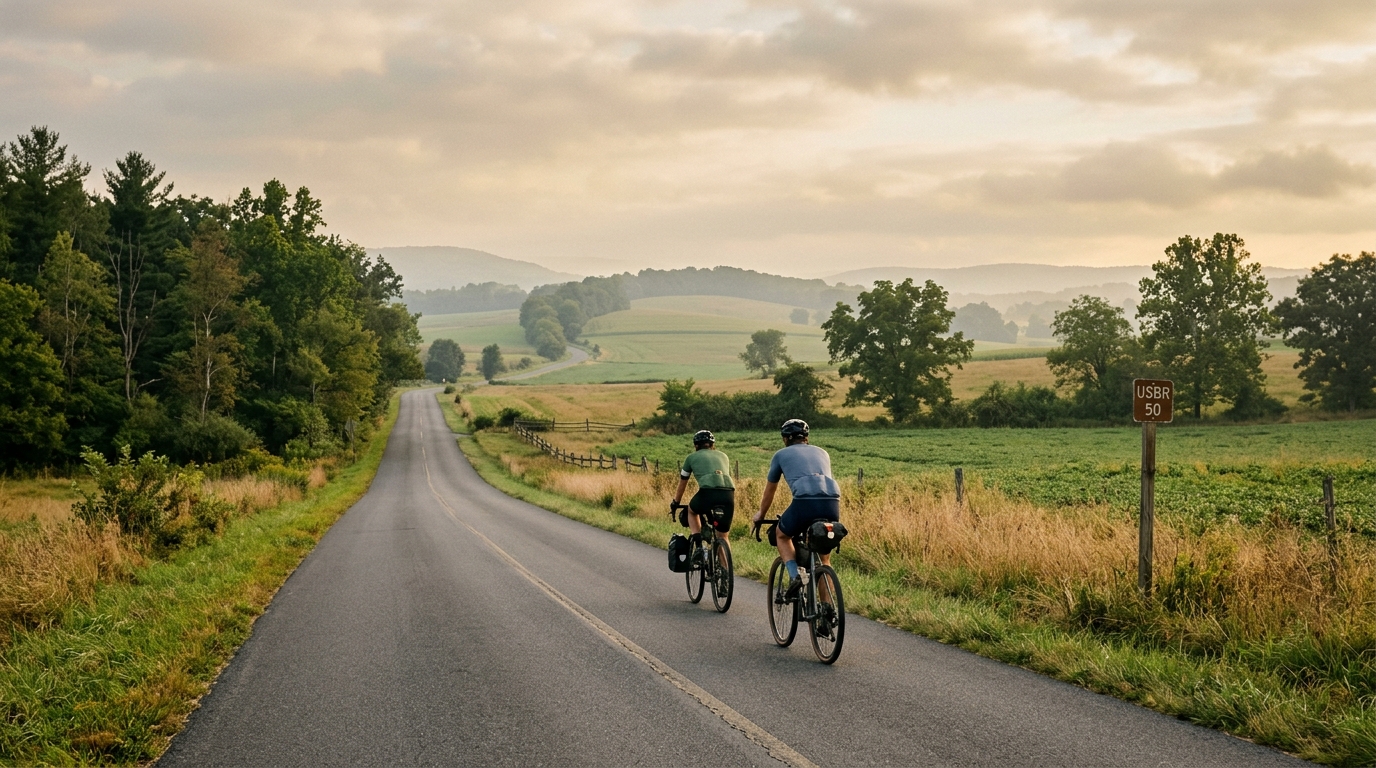
U.S. Bicycle Route 50 in Pennsylvania
A long asphalt point-to-point across Pennsylvania, USBR 50 is defined by distance, low total elevation gain, and steady endurance pacing.
- Distance
- 270.7km
- Climbing
- 441m
- Surface
- —
- Shape
- Point-to-point
The route
Elevation profile
U.S. Bicycle Route 50 in Pennsylvania cycling route
U.S. Bicycle Route 50 in Pennsylvania is a long, asphalt, point-to-point ride that asks more from endurance discipline than climbing strength. At 270.7 km with 441 m of elevation gain, the defining feature is not vertical difficulty. It is the duration of the effort and the need to keep the ride under control from the start.
That low total gain over such a long distance changes the way the route should be read. There are no notable climbs listed, so the route is unlikely to be decided by a single sustained ascent or a major climbing test. Instead, the workload comes from time on the pedals, steady forward pressure, and the accumulation of small efforts across the full distance.
Terrain and ride character
The surface is asphalt, which makes this best approached as a road or endurance setup rather than a mixed-surface ride. The practical advantage is efficiency: on a route this long, reduced rolling resistance and predictable handling matter. The tactical risk is that smooth terrain can encourage riders to sit slightly above their sustainable pace because nothing feels hard early.
For most riders, the smarter execution is to cap the effort early and let the distance do the work. If pacing by power, this is a route where staying honest relative to FTP matters more than chasing short-term speed. The absence of notable climbs does not make the ride easy. It simply shifts the limiter from climbing capacity to aerobic durability, fueling, position comfort, and patience.
Practical notes
Because this is not a loop, logistics matter before fitness does. Plan the start and finish as separate points, with transport, pickup, or an onward connection sorted before rolling out. A point-to-point route also means weather, fatigue, and mechanical issues are harder to solve by simply cutting back to the start.
Setup and pacing
- Use road-appropriate tires for asphalt rather than overbuilding the bike for rough terrain.
- Prioritize contact-point comfort, since 270.7 km magnifies small fit issues.
- Pace the opening section conservatively. With only 441 m of total gain, there may be fewer natural places to reset after overreaching.
- Treat fueling as a route requirement, not an afterthought. The main challenge is sustaining output across the full distance.
Bottom line
U.S. Bicycle Route 50 in Pennsylvania is not a climb-focused test. It is a long endurance route on asphalt, and that makes the execution deceptively simple: ride efficiently, stay fueled, and avoid spending energy before the distance has had time to make itself felt.
Related routes
3-Länder-Radweg
A 302.2 km asphalt route in Germany with 1512 m of climbing and point-to-point logistics shaped by the Reußenkreuz climb.
7 Peaks Alpine Challenge
A 110.9 km point-to-point assault through the Victorian Alps, stacking 3404 metres of climbing across relentless, wind-swept high-country ascents.
Aberdare Range
A 46 km asphalt point-to-point through Kenya's Central Highlands that trades big climbs for a relentless 1,700 m of rolling grind.
Abra Málaga
A 45-kilometer point-to-point ribbon of asphalt through Peru's Sacred Valley, climbing 1,699 relentless meters into the high Andes.
Afriski Mahlasela Pass
A 112.8 km asphalt ascent through the Maloti Mountains, climbing 3,384 m to the roof of southern Africa via the storied Mahlasela Pass.
Ahr Cycleway
An 82.9 km asphalt point-to-point route with 541 m of gain, the Ahr Cycleway is a steady endurance ride rather than a climb-focused day.