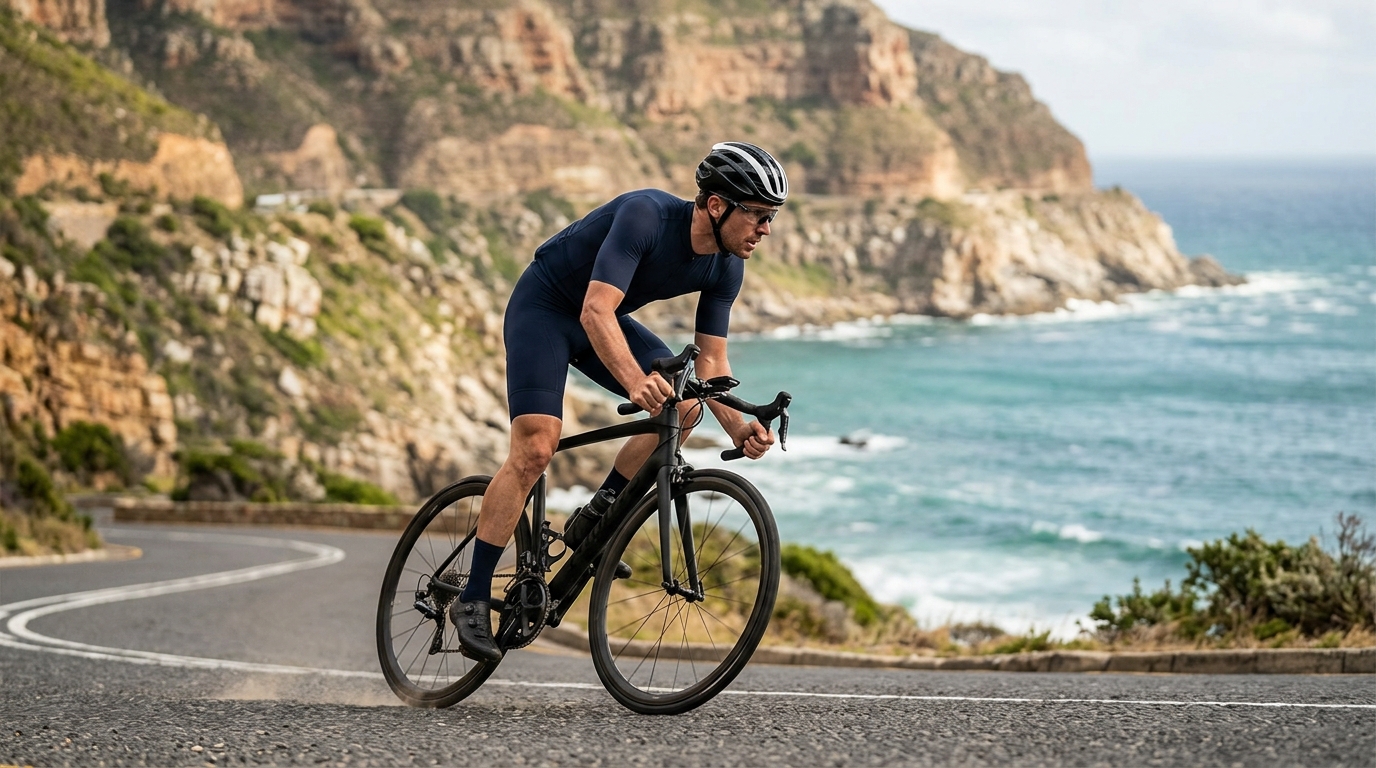
Image generated by our model.
Cycling Power Training: The Complete Guide for Riders
Why Power Is the Gold Standard for Cyclist Training
Heart rate lags. Perceived effort drifts with fatigue, heat, and motivation. Power doesn't. A watt is a watt — it measures the actual work your legs are doing in real time, regardless of how tired you feel, what the weather is doing, or how much coffee you've had.
Cycling power training gives you a fixed, objective reference for every ride. You can set a target, hold it, and know exactly what physiological system you're training. That precision separates riders who progress systematically from riders who just accumulate miles.
What a Power Meter Actually Measures
A power meter calculates power output in watts by measuring torque (force applied to the drivetrain) and cadence (how fast you're pedaling). Multiply the two and you get power.
Power meters are built into:
- Cranks or spider — measures total power directly at the source
- Pedals — easy to swap between bikes, measures left and right independently
- Rear hub — accurate but limited to one wheel
- Chainring or bottom bracket — less common, varies by brand
Left-only meters measure one leg and double the number. They're accurate enough for tracking trends, but bilateral devices give you more data if leg imbalance is a concern.
If you're comparing models or deciding which unit suits your setup, check the /glossary/power-meter entry for a breakdown of measurement methods.
FTP: The Foundation of Power-Based Training
Functional Threshold Power (FTP) is the highest average power you can sustain for roughly an hour. It's the reference number everything else scales from. Train above it and you're in high-intensity territory. Train below it and you're building aerobic base or recovering.
FTP matters because it defines your training zones. Without an accurate FTP, your zones are wrong, your targets are wrong, and you're guessing — which defeats the purpose of having a power meter.
How to Test FTP
Several protocols exist. The most widely used:
20-minute test: Ride all-out for 20 minutes, take 95% of the average power. The 5% discount accounts for the fact that 20 minutes isn't quite an hour.
Ramp test: Ride incrementally increasing one-minute steps until you can't continue. Your FTP is estimated from your peak one-minute power. Easier to execute, slightly less precise for some riders, but consistent enough for most.
60-minute TT: Gold standard in theory, brutal in practice. Use it if you have a race or time trial that fits the format.
Re-test every six to eight weeks when your training load is changing significantly, or any time your fitness feels noticeably different from where your zones suggest. Use the /tools/ftp-estimator to get a baseline before your first formal test.
Power Zones Explained
Zones translate your FTP into training targets. Most coaches use a seven-zone model, though five-zone and six-zone systems exist. The underlying physiology is the same regardless of how many zones you draw.
| Zone | Name | % of FTP | Physiological Target |
|---|---|---|---|
| 1 | Active Recovery | < 55% | Flush metabolites, maintain movement |
| 2 | Endurance | 56–75% | Aerobic base, fat oxidation, long duration |
| 3 | Tempo | 76–90% | Sustained aerobic work, muscular endurance |
| 4 | Threshold | 91–105% | Raise FTP, improve lactate clearance |
| 5 | VO2 Max | 106–120% | Expand aerobic ceiling, cardiac output |
| 6 | Anaerobic Capacity | 121–150% | Neuromuscular power, high-end repeatability |
| 7 | Neuromuscular Power | > 150% | Sprint, peak force, very short efforts |
Zone 2 gets underrated. Most riders spend too much time in Zone 3 — hard enough to accumulate fatigue, not hard enough to produce a strong training stimulus. Polarized training approaches deliberately avoid this middle ground, pushing volume into Zone 2 and intensity into Zone 5 and above.
Core Workout Types in Power Training
Threshold Intervals (Zone 4)
The backbone of FTP development. Typical formats:
- 2 × 20 minutes at 95–100% FTP, 5-minute rest between
- 3 × 12 minutes at 100–105% FTP, 4-minute rest
- 4 × 8 minutes at 102–108% FTP, 4-minute rest
Control the intensity. Riding these too hard — especially early — kills the quality of later intervals. The goal is sustained power, not a short surge followed by a death march.
VO2 Max Intervals (Zone 5)
Short, hard, effective. Standard formats:
- 5 × 5 minutes at 110–120% FTP, 5-minute rest
- 8–10 × 3 minutes at 115–125% FTP, 3-minute rest
- 30/30s: 30 seconds on at 130%+ FTP, 30 seconds easy, repeated 20–30 times
These are uncomfortable by design. If they feel manageable, you're not working hard enough.
Sweet Spot Training (88–93% FTP)
Sweet spot sits between Zone 3 and Zone 4. It delivers a high training stimulus per hour of work without the recovery cost of true threshold intervals. Useful for riders with limited training time, and for building volume during base phases.
Typical format: 2–3 × 15–20 minutes at 88–93% FTP.
Endurance Rides (Zone 2)
Long, steady, aerobic. The goal is duration, not intensity. Power should stay solidly below tempo — if you're drifting above 80% FTP, dial it back. These rides build mitochondrial density, fat oxidation efficiency, and aerobic base that supports all higher-intensity work.
Neuromuscular Work (Zone 6–7)
Sprints, standing accelerations, and short maximal efforts. These improve peak power, fast-twitch recruitment, and the ability to respond to surges in a group. Add them to the end of endurance rides or in dedicated sprint sessions.
Building a Training Week Around Power
There's no single correct structure, but a few principles hold across most effective programs:
Limit hard days. Two, occasionally three, quality sessions per week is enough for most riders. More than that usually means the hard sessions aren't hard enough, or the easy sessions aren't easy enough.
Recovery is not optional. Power training generates a specific, measurable load. Training Stress Score (TSS) and Chronic Training Load (CTL) let you track how much work you're accumulating. Without recovery weeks built in, fitness plateaus or reverses.
Progression must be intentional. Add load gradually — either longer intervals, shorter rest, or slightly higher power — rather than changing everything at once.
A sample week for a rider with 8–10 hours available:
- Monday: Rest or active recovery (Zone 1)
- Tuesday: Threshold intervals (Zone 4)
- Wednesday: Endurance ride (Zone 2, 2–3 hours)
- Thursday: VO2 max or sweet spot intervals
- Friday: Rest or short Zone 1 spin
- Saturday: Long endurance ride (Zone 2, 3–5 hours)
- Sunday: Moderate endurance or tempo ride
Adjust based on your event targets. A climber preparing for a mountain stage race trains very differently from a criterium racer building punch and repeatability.
Pacing With Power
One of the most underused benefits of a power meter is pacing. Riders who pace by feel almost always go out too hard and pay for it later. Power gives you a ceiling to hold from the start.
Climbs: Set a target based on your estimated time to the summit. Shorter climbs allow higher percentages of FTP; longer climbs demand more conservative pacing. For reference, see effort benchmarks on specific ascents like /climbs/alpe-d-huez.
Time trials: Aim for even or slightly negative splits. A common mistake is riding the first third at 10–15 watts above target — it feels controlled, but the cost compounds.
Group rides and races: Power won't pace these for you in real time, but reviewing the file afterward shows exactly where you blew matches and how hard the race actually was compared to solo efforts.
Common Mistakes in Power Training
Testing FTP when fatigued. If you test after a hard training block or with poor sleep, your number will be suppressed. Set zones from a suppressed FTP and every zone is too easy.
Treating every ride as a test. Riders with power meters sometimes push every session to see what they can do. This produces chronic fatigue and no structured adaptation.
Ignoring Zone 2. The data nearly always shows that riders who improve most over a season have high Zone 2 volume. Skipping it in favor of more intervals is a common mistake, particularly among time-crunched riders.
Obsessing over daily metrics. CTL, TSS, and form numbers are trending tools, not exact science. A single number should never override how your body feels.
Failing to progress. Doing the same sessions at the same power week after week produces no new stimulus. The body adapts and stops responding. Periodization — planned variation in load and intensity across weeks and months — is what drives long-term improvement.
Interpreting Your Power Data
Post-ride analysis is where the real learning happens.
- Normalized Power (NP): Accounts for variability in effort. A ride with hard surges and easy coasting will have an NP higher than average power, reflecting the physiological cost more accurately.
- Intensity Factor (IF): NP divided by FTP. An IF of 0.75 is an endurance ride; 0.90 is a threshold session; above 1.0 means you were working harder than FTP for the duration.
- TSS: IF² × duration in hours × 100. A single number expressing the training load of a ride.
- Power-duration curve: Shows your best power across durations from one second to multiple hours. Useful for identifying whether you're a punchy, short-effort rider or a sustained-power specialist — and where your gaps are.
Track these across weeks and months, not day-to-day. Trends tell you whether training is working.
Getting Started Without Overcomplicating It
If you're new to power training, the priority list is short:
- Get a power meter and pair it to your computer or head unit.
- Do an FTP test and set your zones.
- Build two structured sessions per week around those zones — one threshold or sweet spot, one endurance.
- Keep easy days easy. Check the wattage.
- Retest every six to eight weeks and adjust.
That's it to start. Complexity can come later. The biggest gains come from simply training in the right zones consistently — and power is the tool that tells you whether you're doing that.