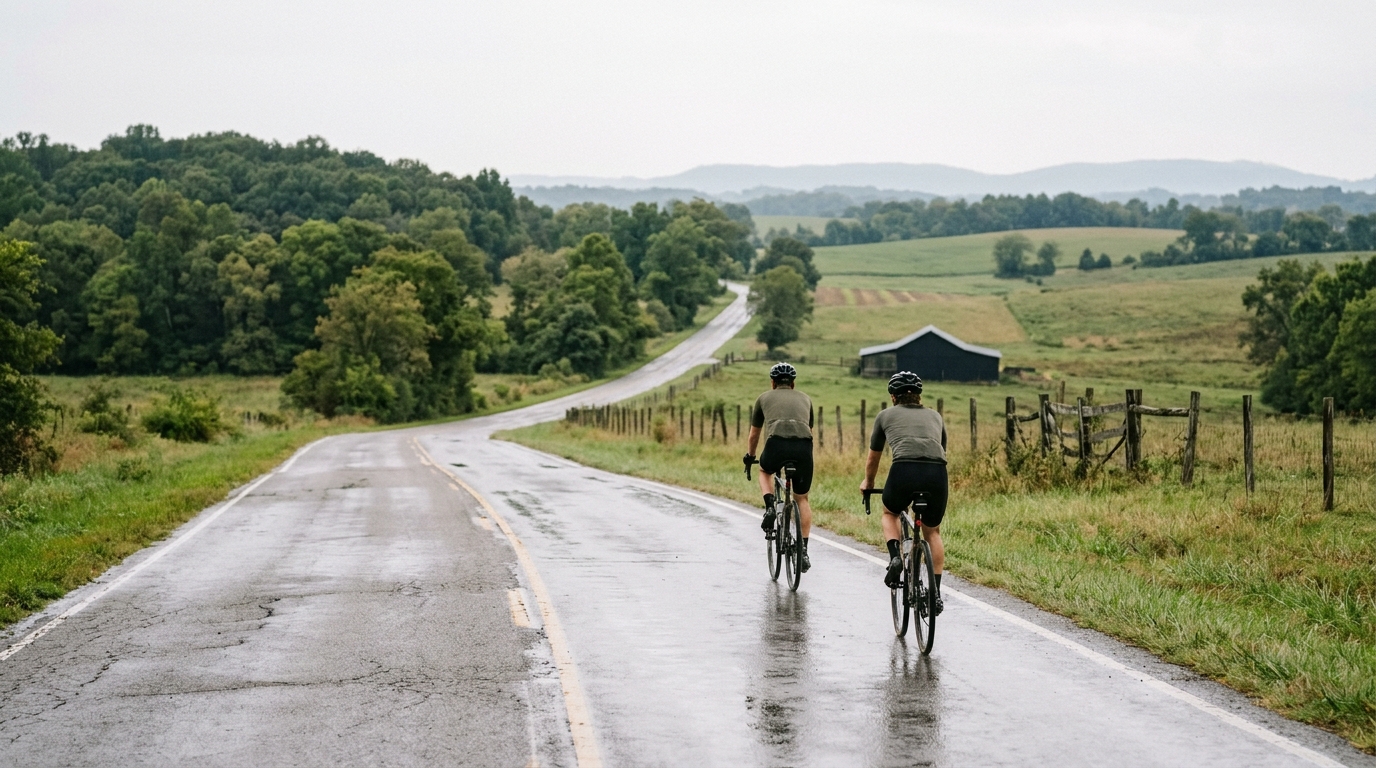
U.S. Bicycle Route 23 in Tennessee
A 289.7 km asphalt, point-to-point route through Tennessee with 1010 m of climbing and no listed notable climbs.
- Distance
- 289.7km
- Climbing
- 1,010m
- Surface
- —
- Shape
- Point-to-point
The route
Elevation profile
Route character
U.S. Bicycle Route 23 in Tennessee is a long asphalt point-to-point ride built more around endurance management than decisive climbing. At 289.7 km with 1010 m of elevation gain, the route asks for steady pacing, durable fueling habits, and good logistical planning rather than a single high-output mountain effort.
The key detail is the relationship between the distance and the climbing. The total gain is meaningful, but it is not the profile of a route defined by major ascents. With no notable climbs listed, the difficulty should come from accumulation: repeated changes in grade, long time on the bike, weather exposure, and the discipline required to keep effort controlled over a full-distance road route.
Terrain and pacing
Expect an asphalt road route where efficiency matters. A road bike setup is the natural fit, but the bigger decision is not equipment category - it is how conservatively to ride the opening sections. On a route this long, early surges have a compounding cost. The smartest pacing strategy is to stay below the intensity that feels exciting early and reserve real effort for later, when fatigue makes even modest rises feel more selective.
Because the route is not a loop, the ride has a different feel from a local circuit. There is no built-in return to the start, so the finish has to be treated as a destination. That changes the planning equation: transport, overnight options, pickup timing, and bail-out flexibility all matter more than they would on a closed course.
What to expect
The absence of listed notable climbs does not make the route easy. It simply shifts the limiter. Instead of preparing for one named ascent, riders should prepare for long-duration output on asphalt with enough elevation gain to punish poor fueling or inconsistent pacing.
Practical priorities:
- Plan the ride as a point-to-point effort, not an out-and-back.
- Build a fueling plan around total time, not just distance.
- Use gearing that lets you stay smooth when fatigue sets in.
- Check current surface and routing details before riding, even though the listed surface is asphalt.
- Treat the 1010 m of gain as cumulative load rather than a single tactical feature.
Rider fit
This is best suited to riders who want a sustained road endurance route rather than a climb-focused challenge. If you are using it as a training target, anchor the effort around aerobic durability and repeatable pacing. Knowing your sustainable intensity through /glossary/ftp can help keep the day controlled, but the real performance marker here is whether you can keep eating, pedaling, and making good decisions deep into the route.
Related routes
3-Länder-Radweg
A 302.2 km asphalt route in Germany with 1512 m of climbing and point-to-point logistics shaped by the Reußenkreuz climb.
7 Peaks Alpine Challenge
A 110.9 km point-to-point assault through the Victorian Alps, stacking 3404 metres of climbing across relentless, wind-swept high-country ascents.
Aberdare Range
A 46 km asphalt point-to-point through Kenya's Central Highlands that trades big climbs for a relentless 1,700 m of rolling grind.
Abra Málaga
A 45-kilometer point-to-point ribbon of asphalt through Peru's Sacred Valley, climbing 1,699 relentless meters into the high Andes.
Afriski Mahlasela Pass
A 112.8 km asphalt ascent through the Maloti Mountains, climbing 3,384 m to the roof of southern Africa via the storied Mahlasela Pass.
Ahr Cycleway
An 82.9 km asphalt point-to-point route with 541 m of gain, the Ahr Cycleway is a steady endurance ride rather than a climb-focused day.