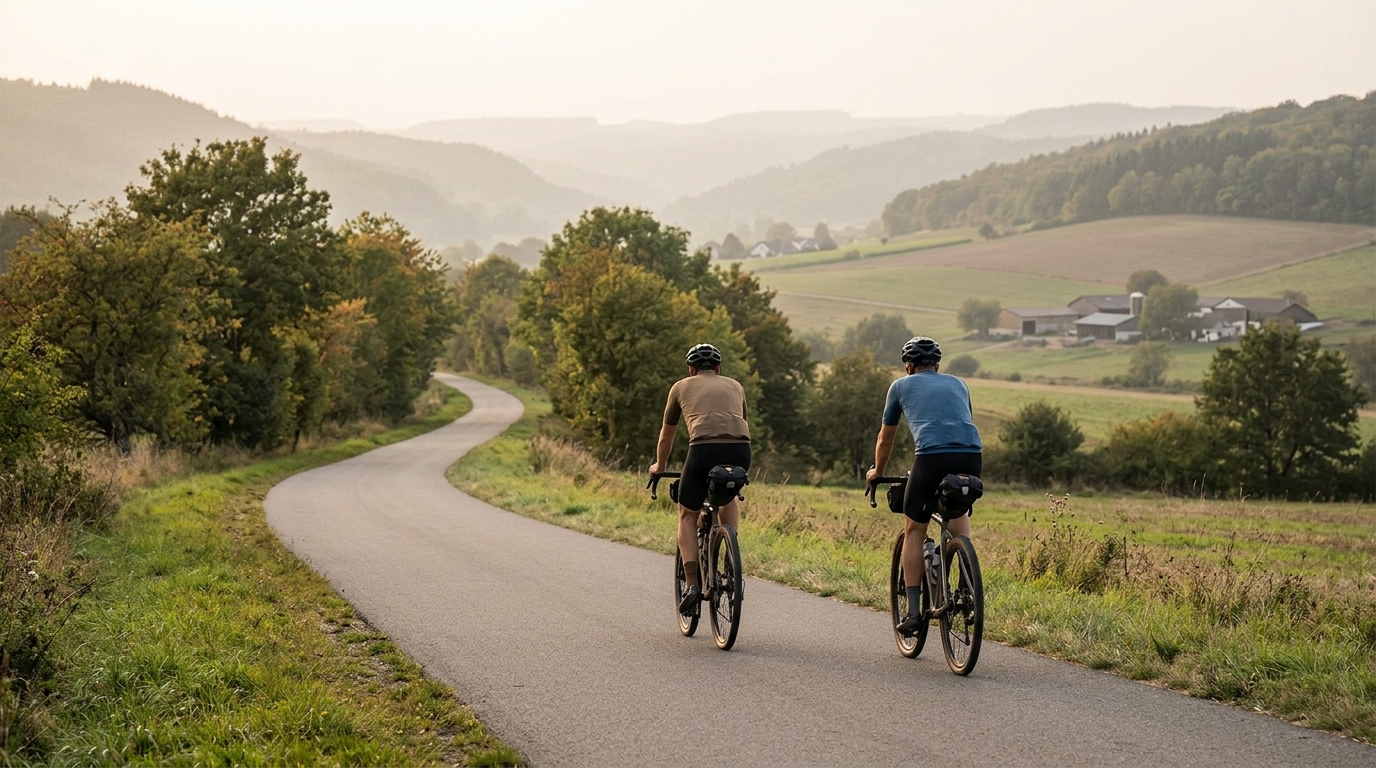
Ruwer-Hochwald-Radweg
An asphalt point-to-point route in Germany with modest elevation gain, suited to steady endurance riding rather than climbing-focused efforts.
- Distance
- 54.5km
- Climbing
- 104m
- Surface
- —
- Shape
- Point-to-point
The route
Elevation profile
Ruwer-Hochwald-Radweg cycling route overview
The Ruwer-Hochwald-Radweg cycling route is a 54.5 km asphalt ride in Germany with 104 m of elevation gain. That profile defines the experience more clearly than any label could: this is not a route built around climbing, repeated accelerations, or summit-based pacing. It is a point-to-point ride where the main task is holding a smooth, controlled effort over a moderate distance.
Because the route is not a loop, logistics matter more than terrain difficulty. Before starting, decide whether the day is a one-way ride, a return on the same route, or a route that needs transport at the far end. For many riders, that planning choice will shape the effort more than the climbing does.
Terrain and ride character
With only 104 m of gain across 54.5 km, the route should feel low-relief rather than selective. There are no notable climbs listed, so the ride is unlikely to force big changes in pacing or require climb-specific gearing decisions. Instead, it rewards consistency: settling into endurance power, keeping cadence stable, and avoiding the stop-start rhythm that can turn an otherwise gentle ride into a less efficient one.
The asphalt surface makes the route accessible to a wide range of bikes. A road bike will suit riders looking for a steady aerobic session, while an all-road, touring, or hybrid setup also makes sense if comfort is the priority. Since the surface is listed as asphalt, the main equipment choice is less about off-road capability and more about position, tyre comfort, and how much gear you want to carry.
How to pace it
Treat this as a controlled endurance route rather than a test of climbing form. The low elevation gain means there is little reason to surge early or chase short rises. If you use power, this is the kind of ride where staying beneath threshold and keeping the effort even will likely produce the best outcome. Riders working from zones can frame it as aerobic volume rather than a high-intensity day. For context on setting those targets, see /glossary/ftp.
The main trap is underestimating the distance because the climbing number looks benign. A 54.5 km ride still requires fuelling, pacing discipline, and a clear plan for the finish, especially because the route does not naturally bring you back to the start.
Practical notes
- Surface: asphalt
- Distance: 54.5 km
- Elevation gain: 104 m
- Format: point-to-point, not a loop
- Climbing profile: no notable climbs listed
The Ruwer-Hochwald-Radweg is best approached as a clean, steady ride: efficient, uncomplicated, and shaped by distance and logistics rather than gradients.
Related routes
3-Länder-Radweg
A 302.2 km asphalt route in Germany with 1512 m of climbing and point-to-point logistics shaped by the Reußenkreuz climb.
7 Peaks Alpine Challenge
A 110.9 km point-to-point assault through the Victorian Alps, stacking 3404 metres of climbing across relentless, wind-swept high-country ascents.
Aberdare Range
A 46 km asphalt point-to-point through Kenya's Central Highlands that trades big climbs for a relentless 1,700 m of rolling grind.
Abra Málaga
A 45-kilometer point-to-point ribbon of asphalt through Peru's Sacred Valley, climbing 1,699 relentless meters into the high Andes.
Afriski Mahlasela Pass
A 112.8 km asphalt ascent through the Maloti Mountains, climbing 3,384 m to the roof of southern Africa via the storied Mahlasela Pass.
Ahr Cycleway
An 82.9 km asphalt point-to-point route with 541 m of gain, the Ahr Cycleway is a steady endurance ride rather than a climb-focused day.