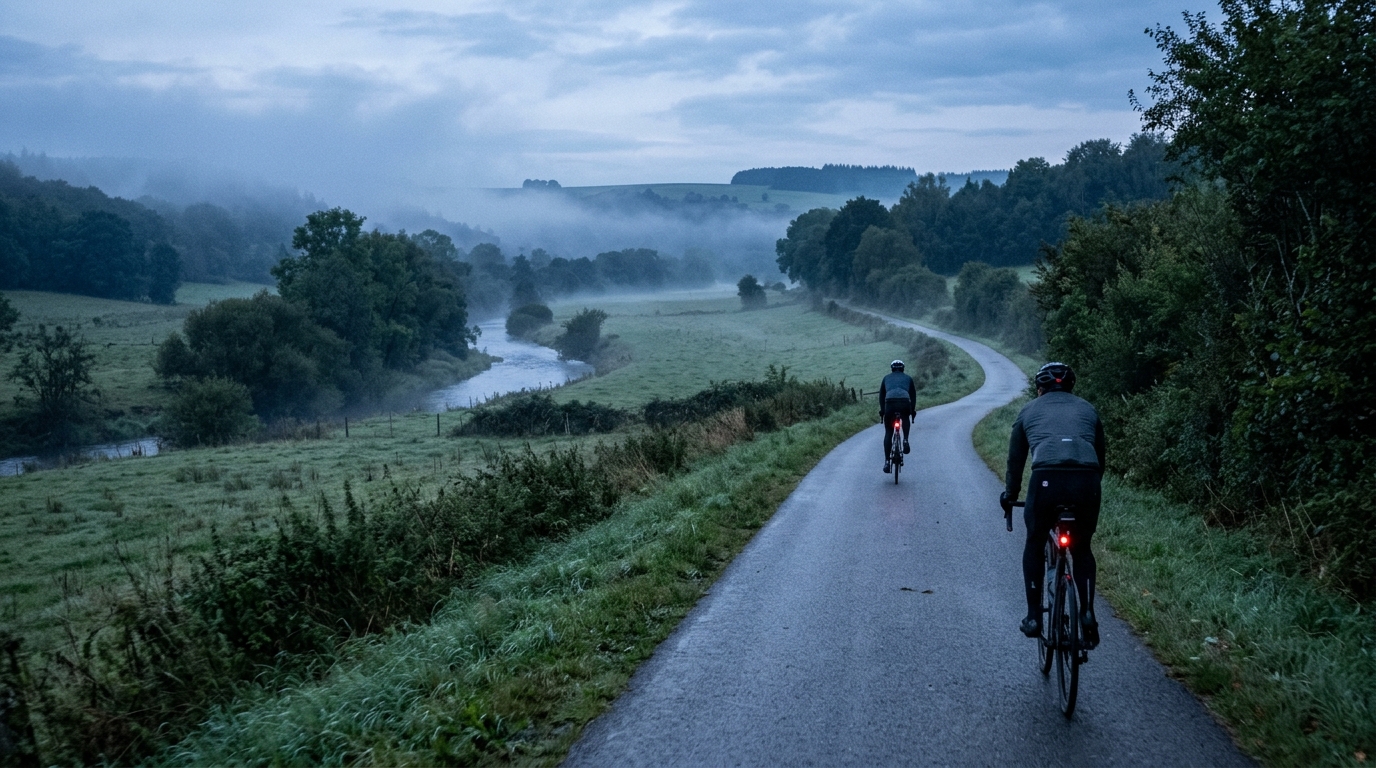
RurUfer cycling route
A long asphalt point-to-point route in Belgium with modest climbing, built for steady pacing rather than decisive gradients.
- Distance
- 184.9km
- Climbing
- 440m
- Surface
- —
- Shape
- Point-to-point
The route
Elevation profile
RurUfer cycling route overview
The RurUfer cycling route is a long point-to-point asphalt ride in Belgium, covering 184.9 km with 440 m of elevation gain. That combination tells you most of what matters: this is not a climbing route, and it is not a punchy loop where the terrain repeatedly resets the race or ride rhythm. It is an endurance route where the main limiter is the ability to stay smooth, fueled, and mentally engaged over a long distance.
With no notable climbs listed, the route's difficulty comes less from gradients and more from duration. That changes the tactical problem. On a climb-heavy ride, effort is often imposed by the terrain. Here, the rider has more control - which sounds easier, but can be its own trap. A route like this rewards discipline because there are fewer obvious terrain cues telling you when to back off.
Terrain and ride character
The asphalt surface should make this a road-bike-friendly route, assuming normal conditions. The modest total elevation gain over 184.9 km points toward a steady, low-vertical profile. Expect a route where momentum matters. Instead of saving everything for a major ascent, the better strategy is to keep the effort contained from the start and avoid unnecessary surges.
This is the kind of ride where riding just above a sustainable effort early can feel harmless, because the road is not forcing obvious recovery moments. Over nearly 185 km, that mistake compounds. The smarter approach is to anchor the ride around endurance pacing, especially if using /glossary/ftp as a reference point. If you are unsure of your current threshold, an estimate from /tools/ftp-estimator can help set realistic intensity before committing to the full distance.
Pacing and practical notes
Because the RurUfer cycling route is not a loop, logistics matter as much as fitness. Plan the start and finish as separate points, and do not treat transport as an afterthought. A non-loop route can be excellent for a purposeful day out, but it gives you fewer easy bailout assumptions than a local circuit.
Key takeaways for execution:
- Pace it like a long endurance ride, not a climb-focused route.
- Keep fueling consistent from early on, since the distance is the main load.
- Avoid repeated accelerations, especially in the first half.
- Check equipment carefully, because 184.9 km on asphalt still gives small issues plenty of time to become ride-ending problems.
- Build the day around point-to-point planning rather than expecting to finish where you started.
Who it suits
This route suits riders who want a long, controlled effort on asphalt without a major climbing focus. It is a good fit for endurance development, steady group riding, or a big-distance day where pacing quality is the real test. The lack of listed notable climbs does not make it easy. It simply shifts the challenge from climbing ability to execution over distance.
Related routes
3-Länder-Radweg
A 302.2 km asphalt route in Germany with 1512 m of climbing and point-to-point logistics shaped by the Reußenkreuz climb.
7 Peaks Alpine Challenge
A 110.9 km point-to-point assault through the Victorian Alps, stacking 3404 metres of climbing across relentless, wind-swept high-country ascents.
Aberdare Range
A 46 km asphalt point-to-point through Kenya's Central Highlands that trades big climbs for a relentless 1,700 m of rolling grind.
Abra Málaga
A 45-kilometer point-to-point ribbon of asphalt through Peru's Sacred Valley, climbing 1,699 relentless meters into the high Andes.
Afriski Mahlasela Pass
A 112.8 km asphalt ascent through the Maloti Mountains, climbing 3,384 m to the roof of southern Africa via the storied Mahlasela Pass.
Ahr Cycleway
An 82.9 km asphalt point-to-point route with 541 m of gain, the Ahr Cycleway is a steady endurance ride rather than a climb-focused day.