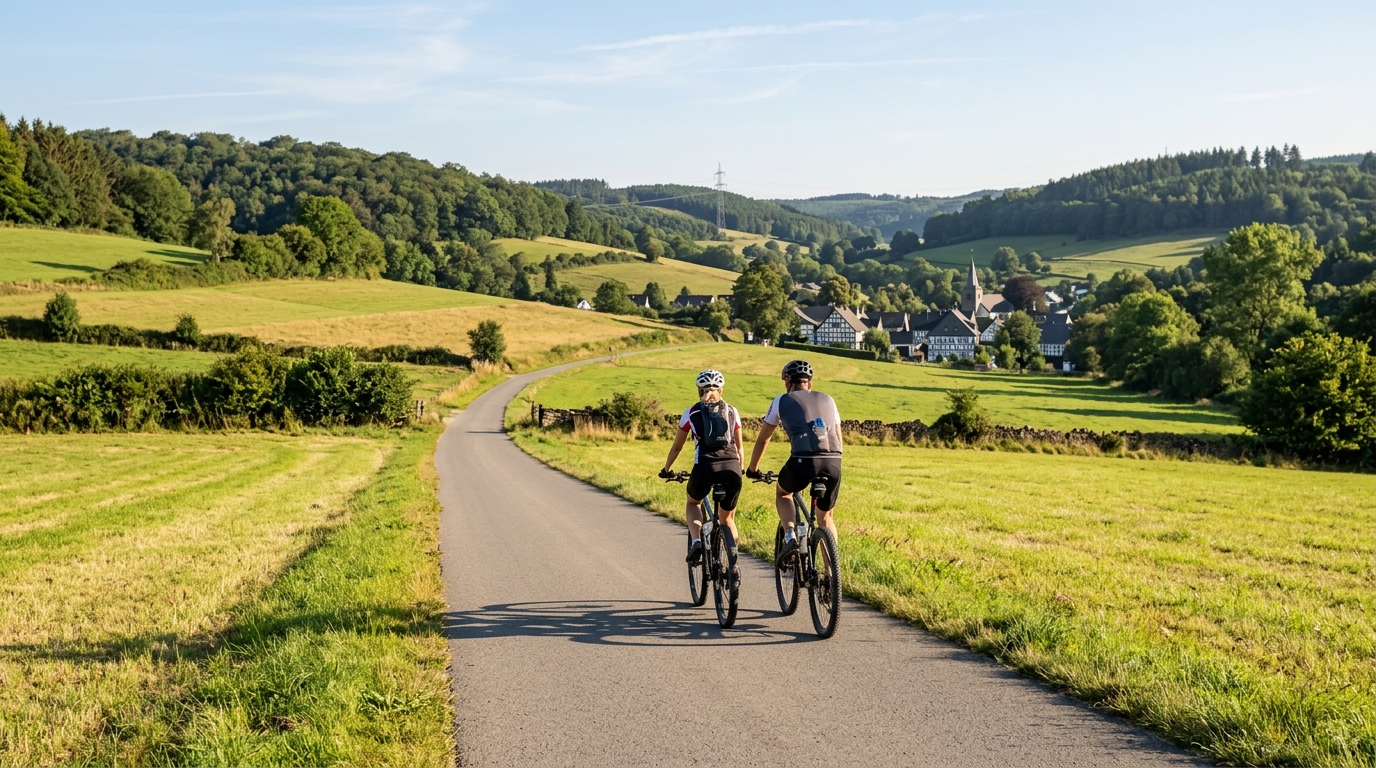
Ruhr-Sieg-Radweg
A 123.4 km asphalt point-to-point route in Germany with 704 m of climbing, best treated as a steady endurance ride rather than a pure climbing test.
- Distance
- 123.4km
- Climbing
- 704m
- Surface
- —
- Shape
- Point-to-point
The route
Elevation profile
Ruhr-Sieg-Radweg cycling route overview
The Ruhr-Sieg-Radweg is a 123.4 km asphalt cycling route in Germany with 704 m of total elevation gain. That combination gives it a clear endurance character: long enough to require real pacing and fuelling discipline, but not defined by sustained mountain climbing.
Because the route is not a loop, logistics matter more than they would on a circular ride. Treat it as a point-to-point day where the ride itself is only one part of the plan. Before starting, decide how you are getting back, where you are finishing, and whether you need a bailout option if the weather, legs, or daylight turn against you.
Terrain and ride character
With 704 m of climbing spread across 123.4 km, the route should feel more like a rolling endurance route than a day built around major climbs. There are no notable climbs listed in the route data, which is useful information in itself. It suggests the main challenge is not one decisive ascent, but the cumulative cost of distance, small rises, and time on the bike.
That changes how the ride should be approached. Rather than saving everything for a named climb, ride the early kilometres with restraint and keep pressure smooth on the rises. The risk on this kind of profile is death by small accelerations: pushing each incline slightly too hard, then paying for it late when the route still has a lot of distance left.
For most riders, this is a good route for controlled endurance work. If using power, keep the bulk of the ride below /glossary/ftp and avoid turning every rise into a threshold effort. If riding by feel, the right intensity is one where the first half feels almost too conservative.
Surface and bike choice
The listed surface is asphalt, so the route suits a road bike, endurance bike, or fast all-road setup. The main equipment priority is not off-road capability, but comfort and efficiency over a long paved ride. Tyres that balance speed with puncture resistance make more sense than chasing a fragile race setup.
Because the route distance is substantial, contact-point comfort matters. Small fit issues that are irrelevant on a short spin can become limiting over 123.4 km. Check saddle position, bar comfort, and clothing before committing to the full route.
Practical pacing notes
Start easier than the distance tempts you to. The absence of listed major climbs does not make the ride easy; it simply changes where the difficulty appears. The decisive factor is likely to be how steadily you manage energy over the full route.
A sensible approach:
- Ride the opening section below your normal all-day effort
- Keep climbs controlled rather than punchy
- Eat and drink early, not only once fatigue is obvious
- Save a margin for the final third, where accumulated fatigue will matter most
- Plan return transport because the route is point-to-point
Bottom line
The Ruhr-Sieg-Radweg is best understood as a long paved endurance route: 123.4 km, 704 m of gain, and no listed signature climb to dominate the day. Its difficulty comes from duration and consistency. Ride it patiently, keep the effort even, and the route becomes a strong aerobic day rather than an avoidable late-ride grind.
Related routes
3-Länder-Radweg
A 302.2 km asphalt route in Germany with 1512 m of climbing and point-to-point logistics shaped by the Reußenkreuz climb.
7 Peaks Alpine Challenge
A 110.9 km point-to-point assault through the Victorian Alps, stacking 3404 metres of climbing across relentless, wind-swept high-country ascents.
Aberdare Range
A 46 km asphalt point-to-point through Kenya's Central Highlands that trades big climbs for a relentless 1,700 m of rolling grind.
Abra Málaga
A 45-kilometer point-to-point ribbon of asphalt through Peru's Sacred Valley, climbing 1,699 relentless meters into the high Andes.
Afriski Mahlasela Pass
A 112.8 km asphalt ascent through the Maloti Mountains, climbing 3,384 m to the roof of southern Africa via the storied Mahlasela Pass.
Ahr Cycleway
An 82.9 km asphalt point-to-point route with 541 m of gain, the Ahr Cycleway is a steady endurance ride rather than a climb-focused day.