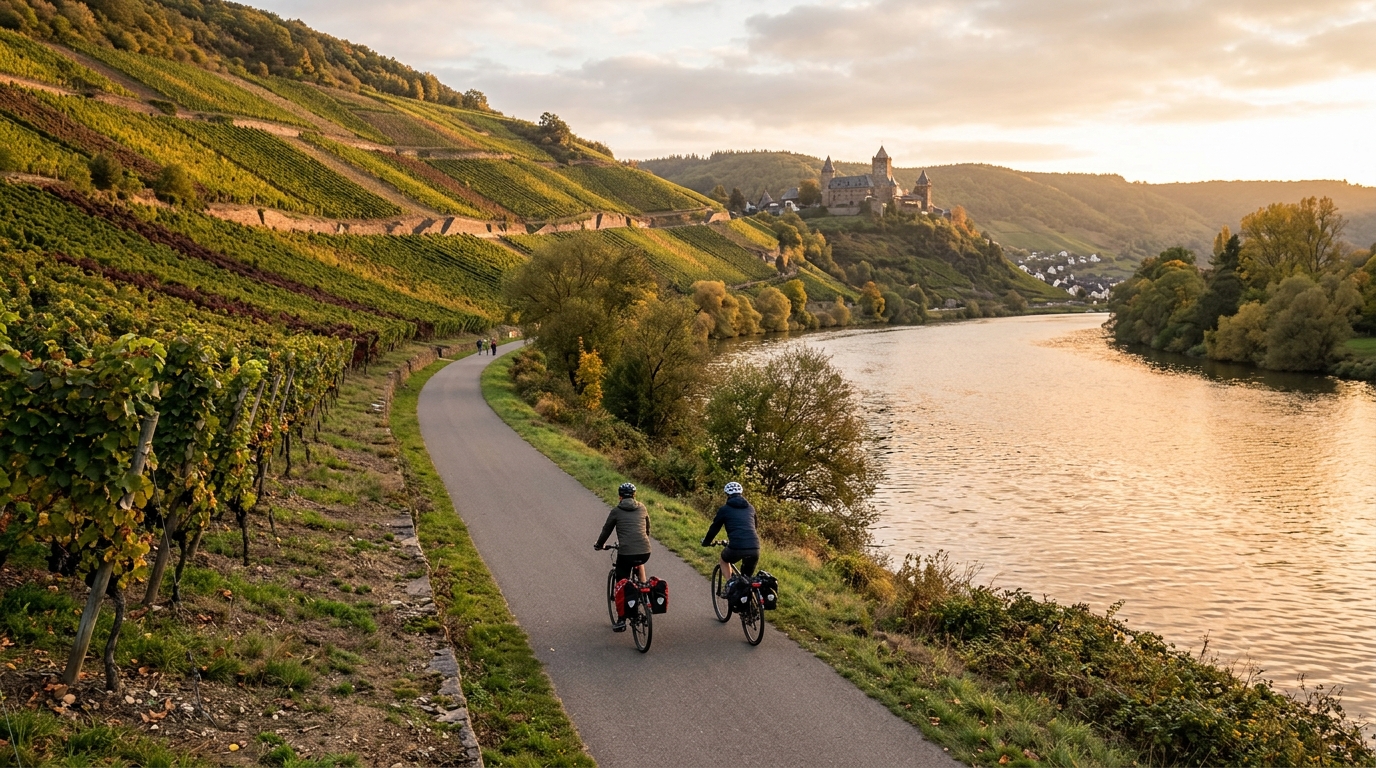
Mosel-Radweg
A practical guide to the 334.8 km Mosel-Radweg, an asphalt point-to-point route where distance matters far more than climbing.
- Distance
- 334.8km
- Climbing
- 445m
- Surface
- —
- Shape
- Point-to-point
The route
Elevation profile
Mosel-Radweg cycling route overview
The Mosel-Radweg is a long, asphalt, point-to-point cycling route in Germany. On paper, the defining number is not the climbing. It is the 334.8 km distance paired with only 445 m of elevation gain. That combination gives the route a very specific character: this is an endurance ride where the load builds through duration, position, nutrition, and consistency rather than repeated hard climbing.
That matters for how to approach it. A route with this little elevation gain over this much distance rewards riders who can hold a controlled, sustainable effort for hours. The danger is not being forced over a major climb, since no notable climbs are listed. The danger is riding too hard early because the terrain does not immediately punish you. On a route like this, small pacing errors can compound quietly.
Terrain and ride feel
The surface is asphalt, which makes the Mosel-Radweg well suited to steady road riding. With no listed notable climbs and 445 m of total gain across the full route, expect the effort profile to be relatively even. That does not make it easy. It simply shifts the challenge from short-term intensity to long-term durability.
For stronger riders, this is the kind of route that can become a controlled aerobic project: settle below threshold, keep the pressure smooth, and avoid unnecessary accelerations. For newer endurance riders, it is a route where pacing should be conservative from the start. The distance is long enough that comfort, contact points, and fuelling discipline can matter as much as raw fitness.
If you use power, the sensible frame is to think in terms of sustainable endurance riding rather than chasing high numbers. Keeping the ride below your true limit is the point. If you need a reference point for effort management, see /glossary/ftp, but the practical rule is simple: the route gives you plenty of kilometres to pay for early overconfidence.
Practical notes
Because the Mosel-Radweg is not a loop, logistics deserve attention before the ride. You are not automatically finishing where you started, so transport, overnight planning, or a return strategy should be part of the route plan rather than an afterthought.
The asphalt surface reduces the need for specialist off-road equipment, but the distance still argues for reliability. Prioritise a bike setup you can sit on comfortably for a long day, or for repeated days if splitting the full 334.8 km into stages. Tyre choice, saddle comfort, and storage for food and layers will have more influence than gearing for steep gradients.
How to pace it
The best approach is patient. Treat the opening section as a setup phase, not a place to prove form. With only 445 m of climbing on the route profile, there is limited natural terrain to force recovery, so the rider has to create that discipline manually: steady pressure, regular eating, and no needless surges.
The Mosel-Radweg is best understood as a long endurance route on fast, predictable terrain. It may not ask for climbing fireworks, but it does ask a more subtle question: can you stay efficient, fuelled, and composed all the way through 334.8 km?
Related routes
3-Länder-Radweg
A 302.2 km asphalt route in Germany with 1512 m of climbing and point-to-point logistics shaped by the Reußenkreuz climb.
7 Peaks Alpine Challenge
A 110.9 km point-to-point assault through the Victorian Alps, stacking 3404 metres of climbing across relentless, wind-swept high-country ascents.
Aberdare Range
A 46 km asphalt point-to-point through Kenya's Central Highlands that trades big climbs for a relentless 1,700 m of rolling grind.
Abra Málaga
A 45-kilometer point-to-point ribbon of asphalt through Peru's Sacred Valley, climbing 1,699 relentless meters into the high Andes.
Afriski Mahlasela Pass
A 112.8 km asphalt ascent through the Maloti Mountains, climbing 3,384 m to the roof of southern Africa via the storied Mahlasela Pass.
Ahr Cycleway
An 82.9 km asphalt point-to-point route with 541 m of gain, the Ahr Cycleway is a steady endurance ride rather than a climb-focused day.