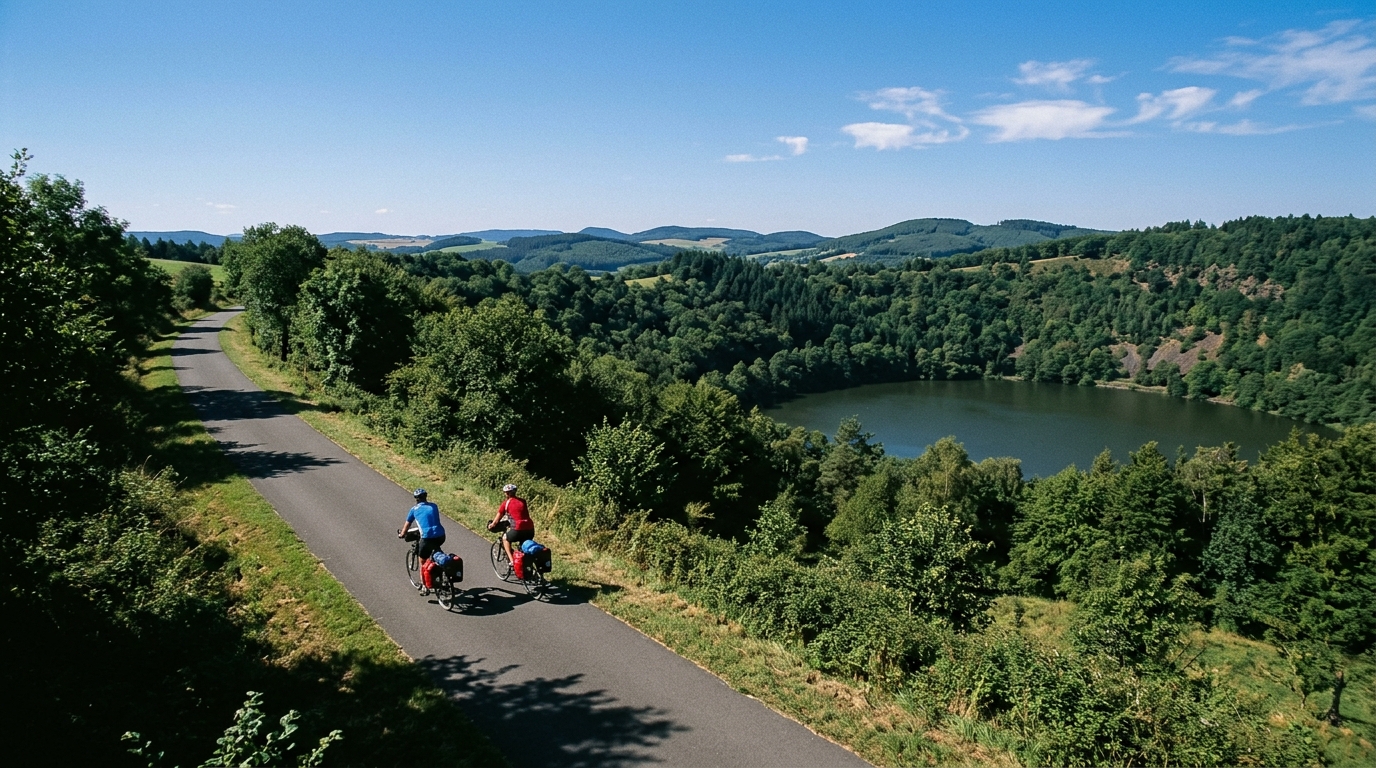
Maare-Mosel-Radweg
A practical guide to the Maare-Mosel-Radweg cycling route: 70.9 km of asphalt, low climbing load, and point-to-point pacing.
- Distance
- 70.9km
- Climbing
- 238m
- Surface
- —
- Shape
- Point-to-point
The route
Elevation profile
Maare-Mosel-Radweg cycling route overview
The Maare-Mosel-Radweg is a 70.9 km point-to-point asphalt route in Germany, with 238 m of total elevation gain. On paper, that combination tells you the most important thing about the ride: this is not a climbing route. It is a sustained endurance outing where rhythm, surface quality, and pacing matter more than managing repeated steep efforts.
Because the route is not a loop, logistics are part of the ride plan rather than an afterthought. You either need transport at the finish, a return option, or the willingness to turn it into an out-and-back. That changes the physiological demand quite a bit. As listed, the route is a controlled aerobic ride. Doubling back would make it a much longer day, even if the climbing profile remains relatively forgiving.
Terrain and ride character
The defining feature is the low climbing load over a 70.9 km distance. With no notable climbs listed, the Maare-Mosel-Radweg should ride as a steady route rather than a route broken up by decisive uphill sections. That favors riders who can hold consistent pressure, settle into an efficient cadence, and avoid unnecessary surges.
The asphalt surface also makes the route well suited to road bikes, endurance bikes, and fast all-road setups. Tire choice does not need to be built around rough terrain based on the listed surface, but comfort still matters over this distance. A bike that lets you stay relaxed and stable will usually be faster than one that only feels sharp for the first part of the ride.
How to pace it
Treat the ride as a steady endurance effort, not a route to attack in pieces. With limited elevation gain, the risk is not one hard climb blowing up the day. The risk is riding too hard early because the terrain allows it, then paying for that sustained pressure later.
If you train with power, this is the kind of route where discipline around /glossary/ftp matters. Stay below the effort that starts to feel costly, especially if you are carrying gear or planning a return journey. If you ride by feel, aim for controlled breathing and a gear that lets you keep momentum without forcing torque through every rise.
Practical notes
- Plan the finish before you start, because the route is not a loop.
- Expect a predominantly smooth ride character based on the asphalt surface.
- Do not over-gear the route. Low elevation gain does not mean zero fatigue.
- Carry enough food and fluid for a continuous 70.9 km ride, especially if your return plan adds distance.
- This is a strong choice for endurance volume, steady pacing practice, or a lower-climbing day when you still want meaningful ride time.
The Maare-Mosel-Radweg cycling route is best understood as a distance-and-rhythm ride. It rewards restraint early, consistency through the middle, and practical planning at both ends.
Related routes
3-Länder-Radweg
A 302.2 km asphalt route in Germany with 1512 m of climbing and point-to-point logistics shaped by the Reußenkreuz climb.
7 Peaks Alpine Challenge
A 110.9 km point-to-point assault through the Victorian Alps, stacking 3404 metres of climbing across relentless, wind-swept high-country ascents.
Aberdare Range
A 46 km asphalt point-to-point through Kenya's Central Highlands that trades big climbs for a relentless 1,700 m of rolling grind.
Abra Málaga
A 45-kilometer point-to-point ribbon of asphalt through Peru's Sacred Valley, climbing 1,699 relentless meters into the high Andes.
Afriski Mahlasela Pass
A 112.8 km asphalt ascent through the Maloti Mountains, climbing 3,384 m to the roof of southern Africa via the storied Mahlasela Pass.
Ahr Cycleway
An 82.9 km asphalt point-to-point route with 541 m of gain, the Ahr Cycleway is a steady endurance ride rather than a climb-focused day.