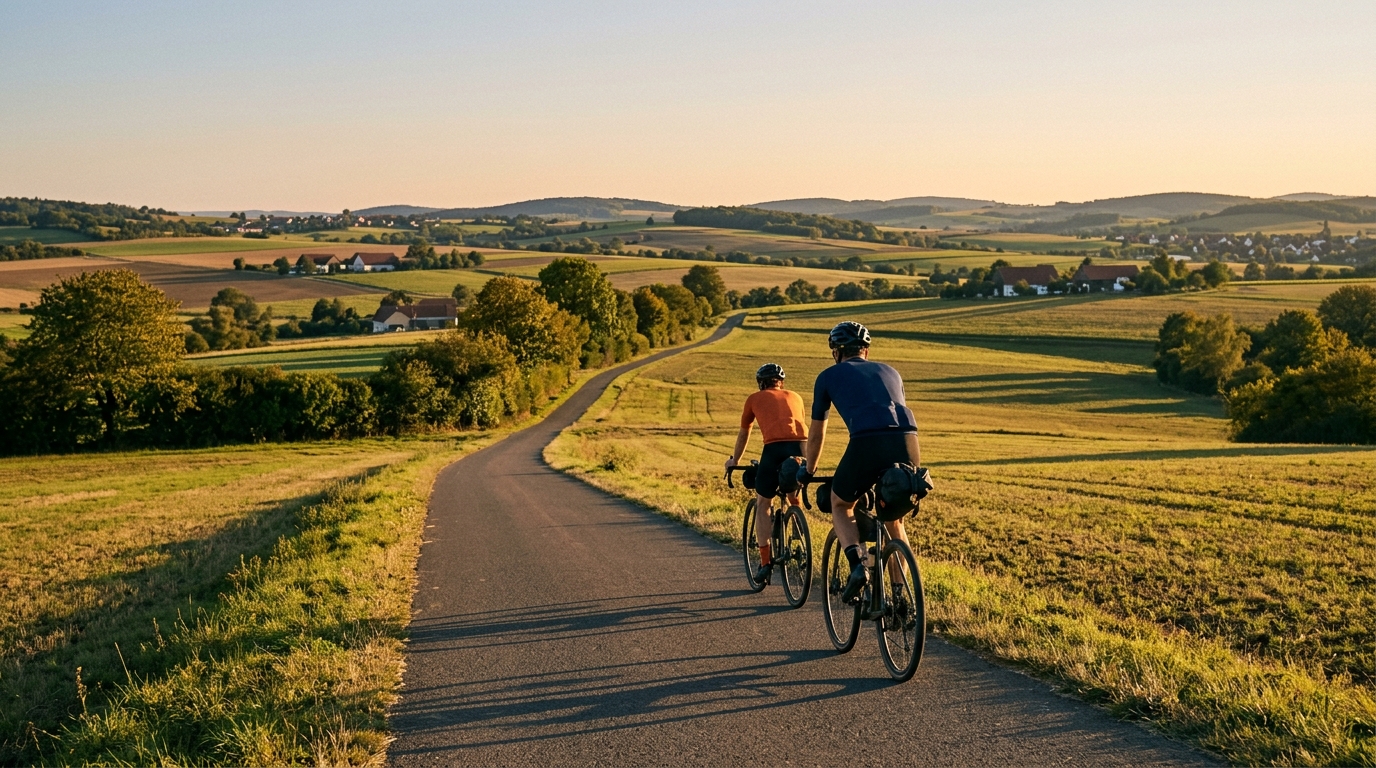
Hessian long-distance cycle route R7
A 297 km asphalt point-to-point route with 1092 m of gain, the R7 is defined more by duration, pacing, and logistics than by major climbs.
- Distance
- 297km
- Climbing
- 1,092m
- Surface
- —
- Shape
- Point-to-point
The route
Elevation profile
Hessian long-distance cycle route R7 cycling route
The Hessian long-distance cycle route R7 is a 297 km asphalt route with 1092 m of elevation gain. On paper, that gives it a clear identity: this is not a climb-driven ride, but it is also not a short roll where distance becomes an afterthought. The main demand is sustained aerobic execution across a long point-to-point course.
That matters because the route’s difficulty is likely to accumulate rather than arrive in one obvious set-piece climb. With no notable climbs listed in the route data, the R7 should be approached as a long endurance ride where small rises, changing rhythm, and time on the bike are the things that wear riders down. The terrain profile suggests the better strategy is restraint early, consistency through the middle, and enough fueling discipline to keep the final portion from becoming a slow grind.
Terrain and ride feel
The surface is asphalt, which keeps the technical side relatively simple. Bike handling should not be the limiting factor in the same way it might be on mixed-surface or gravel routes. That shifts the emphasis toward position, pacing, and efficiency. A road bike or fast all-road setup makes sense, provided comfort is not sacrificed for speed.
The 1092 m of elevation gain across 297 km points toward a rolling or gently undulating route rather than a mountainous one. That does not make it easy. Long routes with moderate climbing can be deceptive because there is rarely a single moment that forces respect. Instead, riders overpace the early flat or faster sections, then pay for it later when the cumulative distance starts to matter.
If using power, keep the effort well below /glossary/ftp for most of the day. If riding by feel, the right intensity should be conversational for long stretches. The route rewards patience more than aggression.
Practical notes
Because the R7 is not a loop, logistics are part of the ride. The start and finish are separate, so transport planning matters before any pacing plan does. A point-to-point route also changes the mental structure of the day: there is no natural return leg, and bailout choices need to be considered before rolling out.
Key setup priorities:
- Choose tires and pressure for efficient asphalt riding, not technical off-road grip.
- Prioritize comfort over a pure race position, because 297 km exposes small fit issues.
- Pace the first half conservatively. The route’s main challenge is duration.
- Fuel from the start rather than waiting for fatigue to appear.
- Plan the finish logistics in advance, since the route does not return to its start.
Who it suits
The R7 is best read as a long-distance endurance route rather than a climbing objective. Riders looking for a huge summit day may find the profile too restrained, but those targeting steady volume, aerobic durability, and clean asphalt kilometres will get a more useful test. The route’s challenge is not whether you can survive one hard climb. It is whether you can keep making good decisions for 297 km.
Related routes
3-Länder-Radweg
A 302.2 km asphalt route in Germany with 1512 m of climbing and point-to-point logistics shaped by the Reußenkreuz climb.
7 Peaks Alpine Challenge
A 110.9 km point-to-point assault through the Victorian Alps, stacking 3404 metres of climbing across relentless, wind-swept high-country ascents.
Aberdare Range
A 46 km asphalt point-to-point through Kenya's Central Highlands that trades big climbs for a relentless 1,700 m of rolling grind.
Abra Málaga
A 45-kilometer point-to-point ribbon of asphalt through Peru's Sacred Valley, climbing 1,699 relentless meters into the high Andes.
Afriski Mahlasela Pass
A 112.8 km asphalt ascent through the Maloti Mountains, climbing 3,384 m to the roof of southern Africa via the storied Mahlasela Pass.
Ahr Cycleway
An 82.9 km asphalt point-to-point route with 541 m of gain, the Ahr Cycleway is a steady endurance ride rather than a climb-focused day.