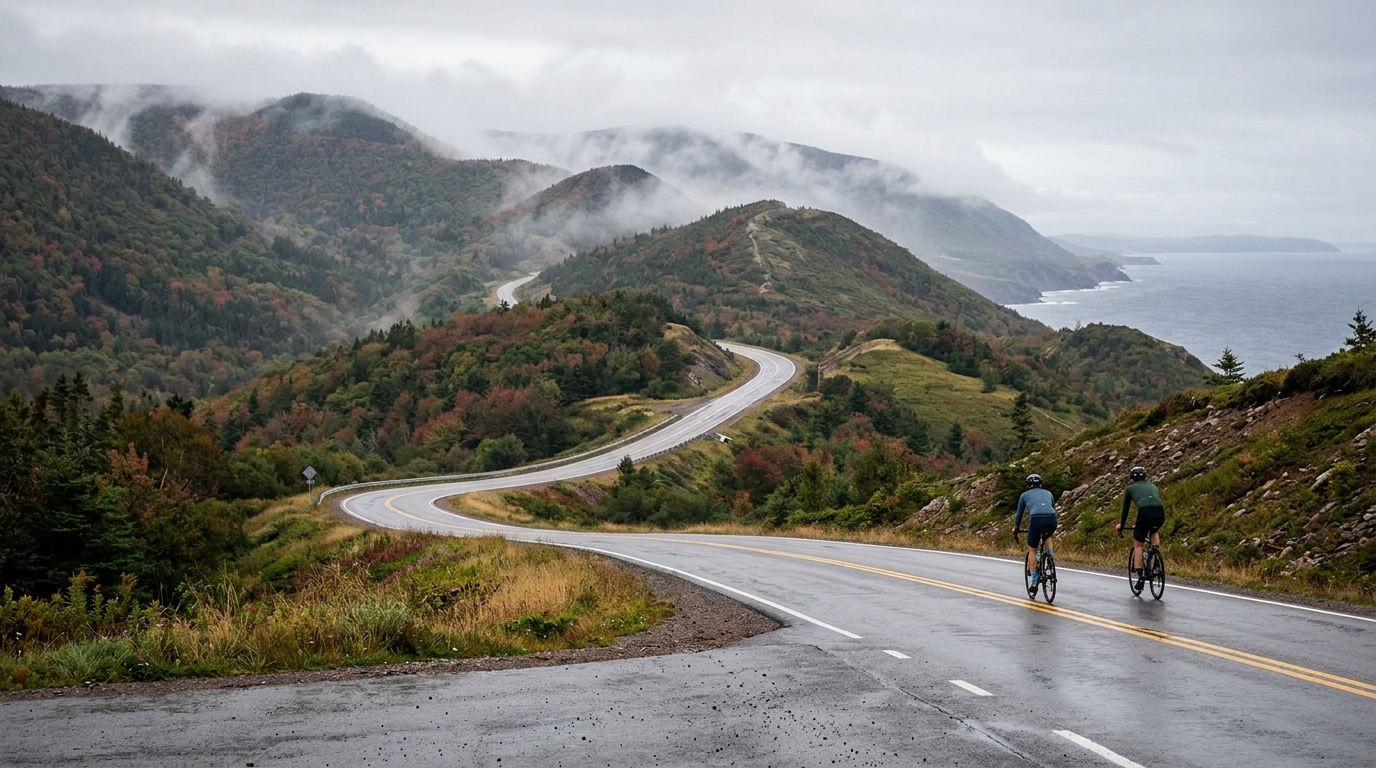
Cabot Trail
A 286.8 km loop around Cape Breton's coastline, packing 3439 m of climbing into one of Canada's most storied rides.
- Distance
- 286.8km
- Climbing
- 3,439m
- Surface
- Asphalt
- Shape
- Loop
The route
Elevation profile
Overview
The Cabot Trail is one of the great set-piece rides of eastern Canada, a 286.8 km loop that begins and ends in the same place after tracing a full circuit of the Cape Breton coastline in Nova Scotia. Over that distance it accumulates 3439 m of climbing, a figure that tells you plenty about what to expect: this is not a flat coastal cruise but a relentlessly undulating road that rises and falls with the shoreline it follows. The combination of serious distance and steady vertical gain makes the Cabot Trail a genuine endurance objective, the kind of route riders build a season around and remember for years afterward.
The Route
Because the Cabot Trail is a loop, you finish exactly where you started, which makes planning refreshingly simple: one start point, one bag drop, one car park to return to. The 286.8 km of road wraps around the peninsula in a continuous ribbon, and the appeal lies in that completeness. There is no out-and-back repetition, no retraced kilometres. Every turn of the pedals carries you forward into new coastline, and the sense of circumnavigation, of going all the way around and coming home, is a large part of why the ride feels iconic rather than merely long.
Key Climbs
The Cabot Trail has no individually catalogued climbs, and that absence is itself the defining characteristic of the route. Rather than a handful of named summits that riders tick off one by one, the 3439 m of total ascent is distributed across the entire 286.8 km loop as an unbroken sequence of rises and descents. The challenge is cumulative. You are rarely climbing a single sustained wall, but you are almost never resting on genuinely flat ground either. This is a rolling route where the difficulty accrues quietly, kilometre after kilometre, until the sheer volume of climbing across the full loop becomes the story. Riders who train for it learn to respect the drip-drip of elevation rather than any one marquee ascent.
Terrain & Surface
The entire loop is paved with asphalt, which shapes the riding experience as much as the elevation profile does. A consistent hard surface means you can commit to descents, hold a rhythm on the rolling sections, and run standard road tyres without second-guessing the ground beneath you. There is no gravel, no cobble, no surprise change of material to manage — just a continuous asphalt road threading the coast. That predictability is welcome on a ride this long, letting you spend your concentration on pacing and on the 3439 m of accumulated climbing rather than on picking a line.
When to Ride
Give yourself a full day. At 286.8 km with 3439 m of climbing, the Cabot Trail is a big undertaking that rewards an early start and a generous time buffer, particularly if you want to enjoy the coastal setting rather than race the clock. Choose a day with settled weather and enough daylight to complete the loop comfortably, and build in stops. Fresh legs matter here: the climbing never lets up, so starting rested makes the back half of the loop far more manageable.
Logistics
The loop format is the great logistical convenience of the Cabot Trail. Start and finish coincide, so you only need to organise a single base — leave the car, ride the 286.8 km, and return to the same spot. Carry enough food and fluid to cover the sustained effort, and pace your 3439 m of climbing so you are not emptied before the loop closes. Standard road gearing suits the smooth asphalt, though gearing that leaves you spinning options for the endless rolling terrain will pay dividends over the full distance.
Summary
The Cabot Trail earns its reputation through scale and completeness: a 286.8 km asphalt loop that climbs 3439 m as it circles the Nova Scotia coast. With no single decisive climb, its difficulty is the sum of countless rolling kilometres, and its reward is the rare satisfaction of riding all the way around and arriving back where you began.