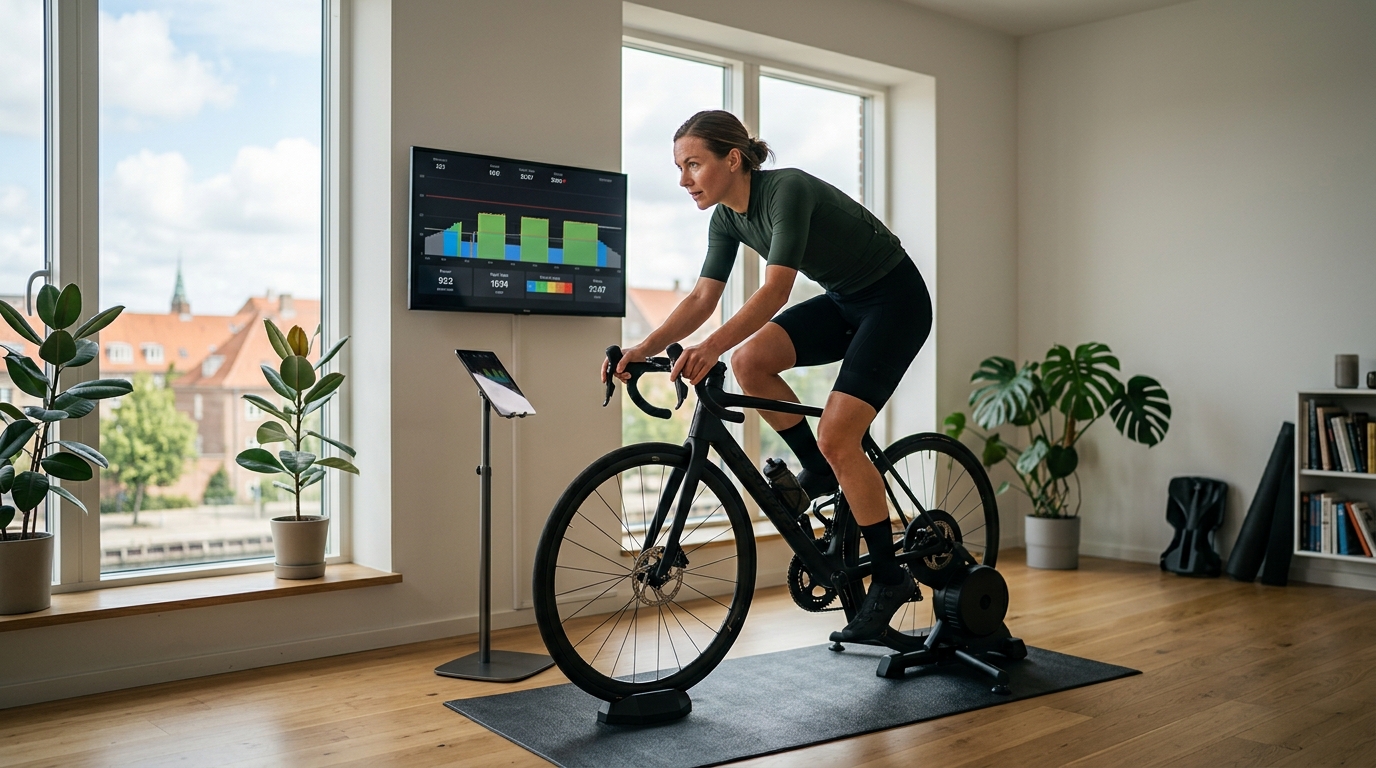
Image generated by our model.
Indoor Cycling Training Plan: A Complete Guide
Why Indoor Training Fails Most Riders
The most common indoor training mistake is riding too hard, too often, with no plan. An hour on the trainer feels wasted unless you're gasping, so riders push into the moderate-hard zone on every session. The result: chronic fatigue, stalled fitness, and eventually a trainer gathering dust.
A structured indoor cycling training plan solves this by giving every session a purpose — and most of those sessions are not meant to hurt.
The Foundation: Know Your Training Zones
Everything in structured training is built around power or heart-rate zones. Without them, "hard" and "easy" are guesswork.
Zones are typically expressed as percentages of your Functional Threshold Power (FTP) — the highest average power you can sustain for roughly an hour. If you don't know your FTP, start with the FTP Estimator before building any plan.
The five zones you'll use most
- Zone 1 – Recovery: Very light spinning. Active recovery between hard days.
- Zone 2 – Aerobic base: Conversational pace. The engine-building zone most riders neglect.
- Zone 3 – Tempo: Comfortably hard. Useful in moderate doses; easy to overdo.
- Zone 4 – Threshold: Around FTP. Demands focused effort and significant recovery.
- Zone 5 – VO2 max: Short, sharp intervals above threshold. High reward, high cost.
The distribution that works for most endurance cyclists is polarized or pyramidal: the bulk of volume in Zones 1–2, a smaller slice of Zone 3, and a targeted dose of Zones 4–5.
Setting Up Your Indoor Environment
Your setup determines whether you'll actually show up each day.
Equipment essentials
- Trainer type: A direct-drive smart trainer gives the most accurate power data and the smoothest ride feel. Wheel-on trainers work but introduce power measurement variability. A dumb trainer with a separate power meter is a legitimate middle ground.
- Cooling: Overheating indoors is a real performance limiter. A high-velocity fan aimed at your core is not optional — it's a training tool.
- Elevation: Raising the front wheel a few centimeters to match the angle of your bike on the road reduces hip strain on longer sessions.
- Sweat management: Sweat volume indoors is much higher than outdoors. Protect your stem and headset with a sweat guard.
Data and software
A training platform that controls your smart trainer — ERG mode for structured intervals, sim mode for virtual climbing — removes the mental overhead of chasing numbers. Focus on executing the session, not managing the device.
Building Your Indoor Cycling Training Plan
Step 1: Define your weekly training hours
Be honest. An overambitious plan abandoned in week three helps no one. Most amateur cyclists can sustain between four and ten hours per week when combining indoor and outdoor riding. Start at the lower end of what you have available, not the upper end.
Step 2: Set a goal and a timeline
Vague goals produce vague training. Pick a target event or fitness benchmark — a gran fondo, a power-to-weight threshold, a first century — and work backward. A typical build cycle runs eight to sixteen weeks.
Step 3: Structure your week
A functional week for a rider with five to seven hours available looks like this:
| Day | Session Type | Duration | Zone Focus |
|---|---|---|---|
| Monday | Rest or recovery spin | 30–45 min | Z1 |
| Tuesday | Threshold intervals | 60–75 min | Z4 |
| Wednesday | Aerobic base | 60–90 min | Z2 |
| Thursday | VO2 max intervals | 45–60 min | Z5 |
| Friday | Rest or active recovery | — | Z1 |
| Saturday | Long ride (outdoor or indoor) | 90–120 min | Z2 |
| Sunday | Endurance or tempo | 60–90 min | Z2–Z3 |
Adjust volume up or down based on your hours budget and recovery capacity. The structure matters more than the specific days.
Step 4: Periodize over the block
Don't hold the same volume and intensity every week. A basic three-week build followed by one recovery week (reduced volume, maintained intensity) is the minimum periodization most riders need. Without recovery weeks, accumulated fatigue masks fitness gains.
Core Indoor Workout Types
Zone 2 base rides
Long, steady, genuinely easy. Most riders go too hard here. If you can't hold a complete sentence, you're above Zone 2. These sessions build the aerobic engine that makes every other zone more effective. On a trainer, distraction helps — podcasts, films, or a virtual route keep a 90-minute Zone 2 session mentally manageable.
Sweet spot intervals
Sweet spot sits just below threshold (roughly 88–93% of FTP) and delivers a high training stimulus relative to recovery cost. A session structure that works well:
- 10-minute warm-up
- 3 × 15 minutes at sweet spot with 5-minute easy recoveries
- 10-minute cool-down
This is an effective format for time-crunched riders who can't always complete a full threshold workout.
Threshold (FTP) intervals
Riding at or very near FTP improves your ability to sustain high power for long efforts. Classic formats:
- 2 × 20 minutes at 95–100% FTP, 5-minute rest
- 3 × 12 minutes at 100–105% FTP, 5-minute rest
Threshold work requires full recovery before repeating — typically 48 hours minimum.
VO2 max intervals
Short, very hard efforts that drive up your aerobic ceiling. Common formats:
- 5 × 4 minutes at 110–120% FTP, equal rest
- 8 × 3 minutes at 115% FTP, 3-minute rest
These sessions should leave you feeling genuinely taxed. One per week is enough for most riders. Two is an upper limit even for well-trained athletes.
Over-unders
Intervals that alternate between just below and just above threshold within the same set. They train your ability to clear lactate while under load — directly applicable to surges on climbs or in group rides.
Example: 3 × 10 minutes alternating 1 minute at 105% FTP / 1 minute at 95% FTP.
Progressive Overload and Retesting FTP
Your FTP will change as you train. If you don't retest periodically, your zones become inaccurate and your training loses its target.
Retest every four to eight weeks, ideally at the end of a recovery week when you're fresh. Use the same protocol each time — consistency in testing matters as much as the result. See the FTP Estimator for ramp test and 20-minute test protocols.
When FTP increases, recalculate all your zones before your next block begins. Training at stale zones is a common reason riders plateau.
Translating Indoor Training to Outdoor Performance
Indoor training is a means to an end. The controlled environment allows precision that's difficult outdoors — no traffic, no descents, no wind — but it needs to connect to real-world riding.
Power matching
If your trainer and outdoor power meter are calibrated, your indoor and outdoor power numbers should align closely. If they don't, investigate calibration before assuming you've gained or lost fitness.
Pacing on climbs
Riders who have done threshold and sweet spot work indoors typically find their pacing on long climbs sharpens significantly. The ability to hold a specific percentage of FTP without wavering is a direct product of structured indoor intervals. Explore the Climbs section for target power calculations on specific ascents.
Heat adaptation side effect
Indoor training in a warm room, especially without a powerful fan, induces some heat adaptation. Riders who train indoors through winter often find they tolerate summer outdoor heat better than those who trained exclusively in the cold. This is a secondary benefit, not a goal — always prioritize adequate cooling for performance sessions.
Common Mistakes to Avoid
- Every ride at the same moderate-hard intensity. This is the single most common error. It creates chronic fatigue without the high-end stimulus of real hard work.
- Skipping warm-ups. Jumping straight into intervals from cold legs increases injury risk and produces worse power numbers.
- Ignoring recovery weeks. Fitness is built during recovery, not during loading. Cut volume by roughly 30–40% every fourth week.
- Using ERG mode for all workouts. ERG mode is useful for tempo and threshold work, but for VO2 max and sprint sessions, switching to resistance or sim mode forces more natural effort and better neuromuscular recruitment.
- Misidentifying Zone 2. Zone 2 should feel almost too easy. If you're working, you're probably in Zone 3.
Putting It Together: A Sample 8-Week Block
Weeks 1–3 (Build): Increase weekly volume by roughly 10% each week. Introduce threshold intervals in week 2, VO2 max intervals in week 3.
Week 4 (Recovery): Drop volume to week 1 levels. Keep one short threshold session. No VO2 max work.
Weeks 5–7 (Second Build): Higher load than the first build block. Extend interval durations rather than adding more intervals.
Week 8 (Recovery + Retest): Reduce volume significantly in the first half of the week. Retest FTP at the end of the week when fresh.
After the retest, recalculate zones and decide whether to extend the block, move into a race-specific phase, or begin a new base period.