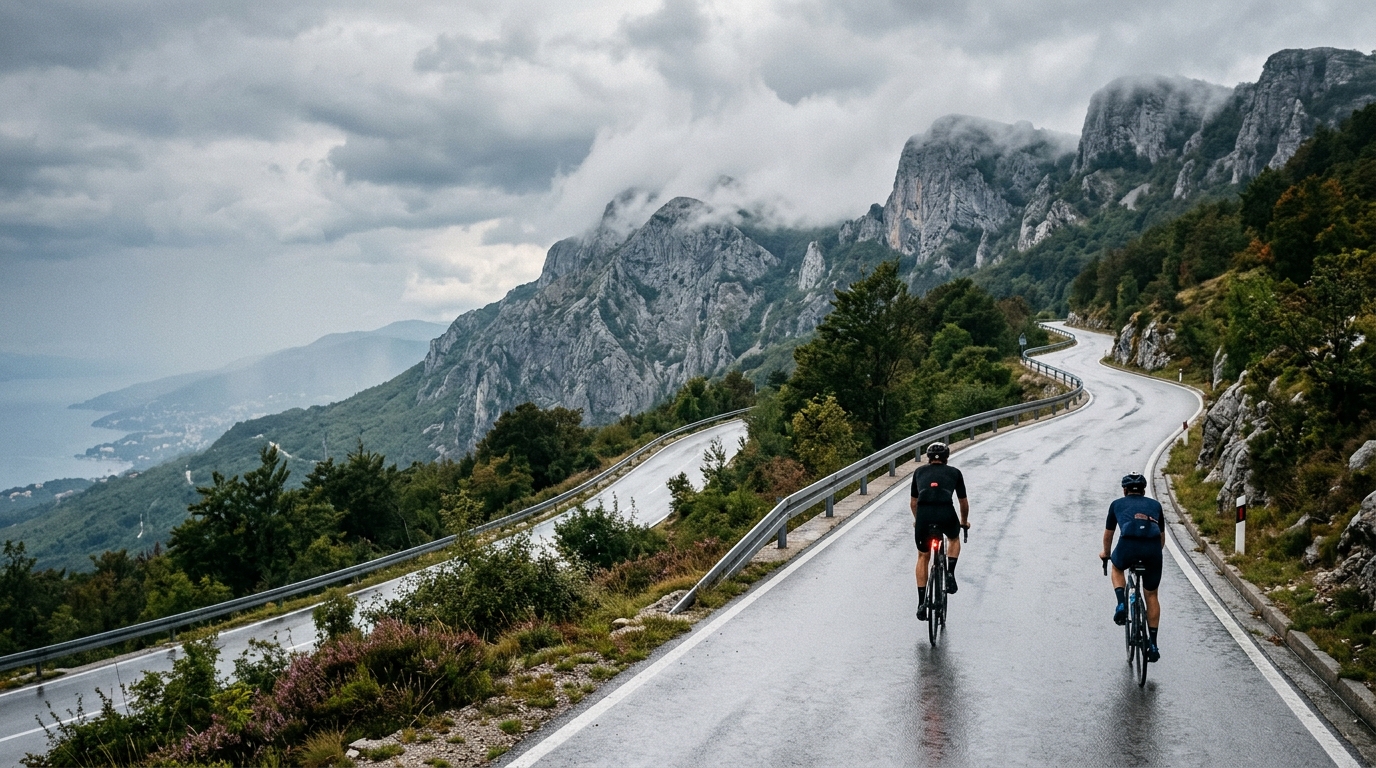
Učka from Opatija
A 36.9 km point-to-point ascent from the Adriatic at Opatija up onto the great grey wall of Učka, all on smooth asphalt.
- Distance
- 36.9km
- Climbing
- 1,348m
- Surface
- Asphalt
- Shape
- Point-to-point
The route
Elevation profile
Overview
Few climbs in Croatia announce themselves as plainly as Učka. From the seafront promenades of Opatija, the mountain stands as a single grey wall, separating the resort coast of the Kvarner Gulf from the green interior of Istria. This route takes that wall head-on: 36.9 kilometres, point-to-point, climbing a substantial 1348 metres from the edge of the Adriatic up onto the massif. It is a ride defined not by a catalogue of famous cols but by one sustained idea — leave the sea behind and keep turning the pedals until the salt air gives way to forest and open sky. That simplicity is exactly what makes it iconic among cyclists who pass through Istria.
The Route
The ride runs as a clean point-to-point line, beginning at sea level in Opatija and finishing high on Učka after 36.9 kilometres. There is no loop to close and no need to double back; the whole effort is a one-way journey from coast to mountain. With 1348 metres of accumulated climbing packed into that distance, the character is relentlessly upward. You trade the busy shoreline of Opatija for quieter, tree-lined kilometres as the road pulls away from the water, and the sense of progress is unusually vivid — every stretch of tarmac gained is altitude you can feel and, when you glance back, altitude you can see over the gulf below.
Key Climbs
This route carries no individually catalogued climbs, and it does not need them. The defining feature here is the climb itself — the whole 36.9 kilometres are the ascent. Rather than ticking off named cols, you settle into a single, honest gradient and hold it. The 1348 metres of climbing arrive steadily rather than in dramatic isolated ramps, rewarding riders who can find a sustainable rhythm and stay patient. It is a route for the diesel engine, not the punchy attacker: the challenge is duration and consistency, the discipline of climbing well for a long time. That unbroken effort, from the water's edge upward, is what gives the ride its reputation.
Terrain & Surface
The entire route is asphalt, which shapes the experience considerably. There is no gravel to manage and no cobbles to rattle over — just consistent, predictable tarmac beneath the tyres from Opatija to the finish. That smooth surface lets you focus entirely on pacing and cadence, choosing a gear and grinding it out without worrying about traction or line choice. On a long climb like this, a reliable road surface is a gift: it keeps the effort clean and repeatable, and it means the mountain, not the terrain underfoot, is the only thing standing between you and the top.
When to Ride
Being a coastal-to-mountain route in Istria, Učka is best enjoyed in the milder shoulder seasons and the cooler parts of summer days. Starting from Opatija at sea level, early mornings offer calmer air and gentler temperatures before the coastal heat builds — a real advantage on a 1348-metre climb where you will be working hard for a sustained stretch. Cooler, clear days also reward the effort with the long views back over the gulf that make the ascent so memorable. Carry enough water for the full climb, since the demand is continuous over the 36.9 kilometres.
Logistics
As a point-to-point route, the main logistical consideration is the finish. You end high on Učka rather than back where you started, so plan your return in advance — whether that means descending the same road back to Opatija under your own power or arranging a pickup at the top. Opatija itself is a well-established resort town and a natural, convenient base, with easy access to the coast road where the climb begins. Because the surface is asphalt throughout, a standard road bike is ideal; the emphasis should be on gearing suited to a long, steady 1348-metre effort rather than on tyre choice.
Summary
Učka from Opatija distils road climbing to its essence: 36.9 kilometres, 1348 metres of ascent, one smooth asphalt line from the Adriatic to the mountain. There are no named cols to collect and no rough terrain to negotiate — only a sustained, honest climb that asks for patience and rewards it with height, views, and the deep satisfaction of riding from the sea straight up onto one of Istria's great landmarks.