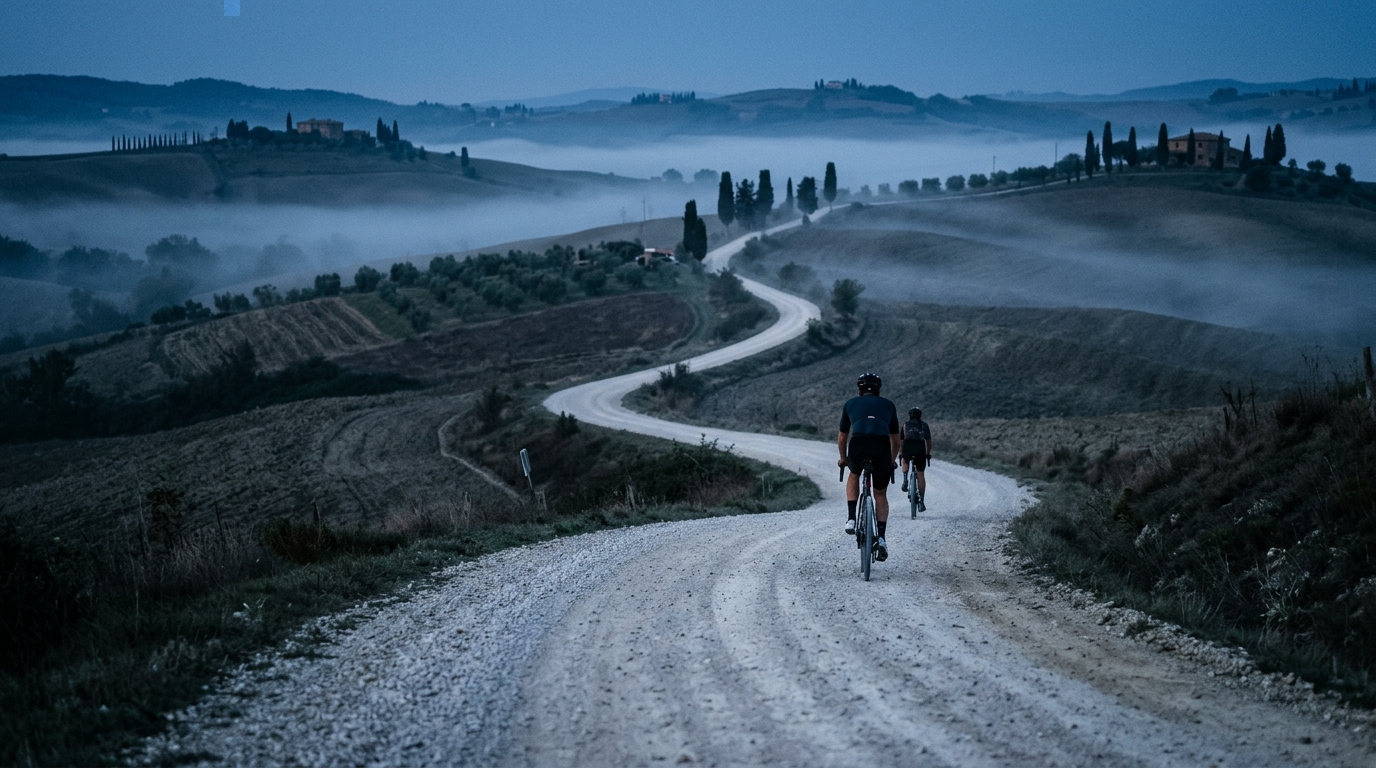
Strade Bianche
A 113.3 km loop across Tuscany's white gravel roads, stacking 1804 m of climbing into one relentless, unforgettable ride.
- Distance
- 113.3km
- Climbing
- 1,804m
- Surface
- Gravel
- Shape
- Loop
The route
Elevation profile
Overview
Strade Bianche is one of cycling's most evocative routes, a 113.3 km loop through the rolling heart of Tuscany that begins and ends in the same place. What sets it apart is not its length but its surface: the famous white gravel roads that thread across the region, kicking up dust in the dry and turning to slick paste in the wet. Across those 113.3 kilometers the route packs in 1804 meters of climbing, a figure that tells you everything about its character. This is not a flat spin through vineyards; it is a ride that never lets you settle, forever tilting up or down, forever asking your legs and your handling for more.
The Route
The loop format is part of the appeal. You roll out from a start line knowing you will return to it, but the road between departure and arrival gives you no rest. The 113.3 km course is built from a series of climbs and descents linked by the region's signature gravel sectors, so the rhythm is constant change. There are no long, flat recovery stretches to hide in. Instead the profile stacks up 1804 m of vertical gain in repeated, sharp doses, meaning you climb, crest, plunge, and climb again. Pacing is everything: go too hard early on the gravel and the accumulated elevation will find you long before the finish.
Key Climbs
Two marquee climbs define the hardest moments of the route. The Valico del Rospatoio is one of the passes the loop crosses, a punchy effort on the region's characteristic unsealed surface where traction and momentum matter as much as raw power. Later, the route tackles the Passo dell'Incrociati, another of the day's decisive climbs. Both are the kind of ascents that reward riders who have paced themselves and punish those who have not, because attacking a gravel climb costs far more than the same effort on tarmac. Between and around these two passes the 1804 m of total climbing accumulates relentlessly, and it is on these named ascents that the ride is most often won or lost.
Terrain & Surface
The surface is the soul of Strade Bianche. These are gravel roads, the white strade bianche that give the route its name, and they change everything about how the 113.3 km feels. Loose stones rob you of grip on the climbs and demand a light, confident touch on the descents. Braking must be earlier and smoother, cornering more measured, and body position looser to let the bike float over the chatter beneath you. In the dry the gravel throws up clouds of dust; after rain it becomes a treacherous, energy-sapping slick. Every one of the 1804 vertical meters is earned on this shifting, unpredictable footing, which is exactly why the route commands such respect.
When to Ride
Because the character of the gravel depends so heavily on conditions, timing your ride matters. The white roads are at their most rewarding when dry and firm, offering the classic dusty Tuscan experience, whereas wet weather transforms the same sectors into a genuine test of nerve and control. Choose a settled, dry spell if you want to enjoy the scenery and the surface rather than fight it, and start early to give yourself ample daylight for a 113.3 km loop that, with its 1804 m of climbing, will take longer than the distance alone suggests.
Logistics
The loop design makes logistics refreshingly simple: start and finish share the same point, so there is no shuttle to arrange and no one-way transport to solve. You can park, ride, and return to where you began. Come prepared for gravel, though. Wider tires, robust tubes or sealant, and spares suited to unsealed roads are essential, and you should carry enough food and water to sustain 1804 m of climbing across 113.3 km, since resupply on the quiet white roads is not guaranteed.
Summary
Strade Bianche distills what makes Tuscan cycling legendary into a single 113.3 km loop. With 1804 m of climbing spread across relentless gravel sectors and defined by the Valico del Rospatoio and Passo dell'Incrociati, it is demanding, beautiful, and utterly unforgettable, a ride every gravel-loving cyclist should experience at least once.
Climbs on this route
Valico del Rospatoio
Cat 37.4 km at 3.85% average, climbing from 184 m to 471 m for a steady 287 m of net gain with an 8.64% pinch.
Passo dell'Incrociati
Cat 3A punchy 4.8 km Category 3 climb averaging 5.65%, rising 273 m to a 507 m summit with a bite of 9.41% along the way.