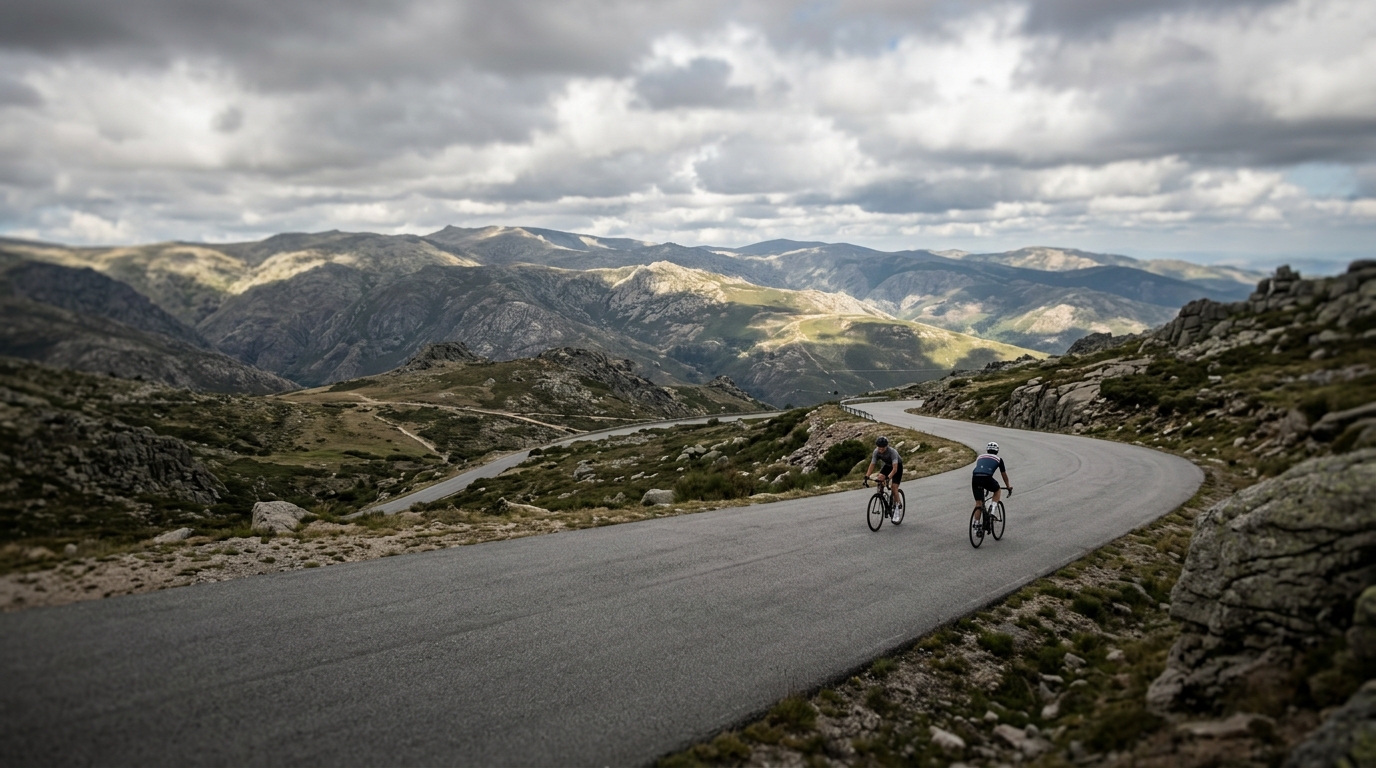
Serra da Estrela
A 44.7 km point-to-point across Portugal's highest ground, stacking 1629 m of climbing on smooth asphalt through the roof of the mainland.
- Distance
- 44.7km
- Climbing
- 1,629m
- Surface
- Asphalt
- Shape
- Point-to-point
The route
Elevation profile
Overview
Serra da Estrela is one of Portugal's defining cycling routes, a 44.7 km point-to-point line that carries you across the highest mountains on the mainland. Over that relatively compact distance the route piles up 1629 m of climbing, a ratio that tells you almost everything about the day ahead: this is a mountain route, not a rolling one. There is no coasting from town to town here. From the first pedal stroke the road tilts, and it keeps asking questions of your legs until the final kilometre. The reward for that effort is a ride through wild, open high country — the kind of ascent that turns a good bike day into a memory you keep returning to.
The Route
Because Serra da Estrela runs point-to-point rather than looping back on itself, the 44.7 km form a single sustained journey rather than a repeated circuit. You start in one place and finish in another, and every metre of the 1629 m of vertical gain moves you deeper into the range. That linear shape rewards planning — you commit to the direction of travel and let the mountain unfold ahead of you — but it also gives the route a satisfying sense of progression. There is no familiar scenery to circle back through; the landscape keeps changing as you climb, and the summit feels genuinely earned rather than merely revisited.
Key Climbs
This route carries no individually catalogued climbs, and that absence is worth reading carefully rather than glossing over. It does not mean the riding is easy — the defining feature of Serra da Estrela is exactly the opposite. Instead of one or two famous named passes, the challenge lives in the relentless accumulation of altitude across the whole 44.7 km. With 1629 m of total climbing packed into a point-to-point line, gradient is the constant companion rather than a set of discrete landmarks. Pace yourself as though the entire route is one long effort, because in practice it is. Save something for the second half; the mountain gives back very little to riders who spend everything early.
Terrain & Surface
The surface throughout is asphalt, which shapes the character of the ride as much as the elevation does. Smooth sealed roads mean the difficulty here is purely vertical — you are not fighting cobbles, loose gravel, or broken tarmac, only gravity and distance. That makes Serra da Estrela accessible to any road bike in good order, and it lets you focus entirely on rhythm and gearing rather than line choice. Fit a climbing-friendly cassette, keep your cadence steady, and let the tarmac do its job. On descents the asphalt allows confident, flowing speed, a welcome release after the sustained work of the climb.
When to Ride
High mountain routes reward good timing. Because Serra da Estrela crosses the highest ground on the Portuguese mainland, conditions at the top can differ sharply from those at the start, so choose a settled, clear day and carry a layer for the exposed upper sections and the fast descents. Milder, longer-daylight periods give you the widest weather margin and the best light across the open landscape. Set out early enough to enjoy the summit without racing the clock, and check the forecast for the high country specifically rather than the valleys below.
Logistics
The point-to-point format is the single most important logistical detail. Since you finish somewhere different from where you start, plan your transport at both ends before you roll out — a shuttle, a second vehicle, or a return leg all work, but none of them should be an afterthought. Carry enough food and water for a sustained 44.7 km of climbing, since services on high mountain roads can be sparse. Confirm your bike is mechanically sound, particularly brakes and gearing, and you will be free to enjoy the climb for what it is.
Summary
Serra da Estrela distils mountain cycling to its essence: 44.7 km, 1629 m of climbing, smooth asphalt, and the highest ground in mainland Portugal. There are no marquee named climbs to tick off — just a long, honest ascent that rewards patience and a steady rhythm. Plan the point-to-point logistics, pick a clear day, and let the mountain do the rest.