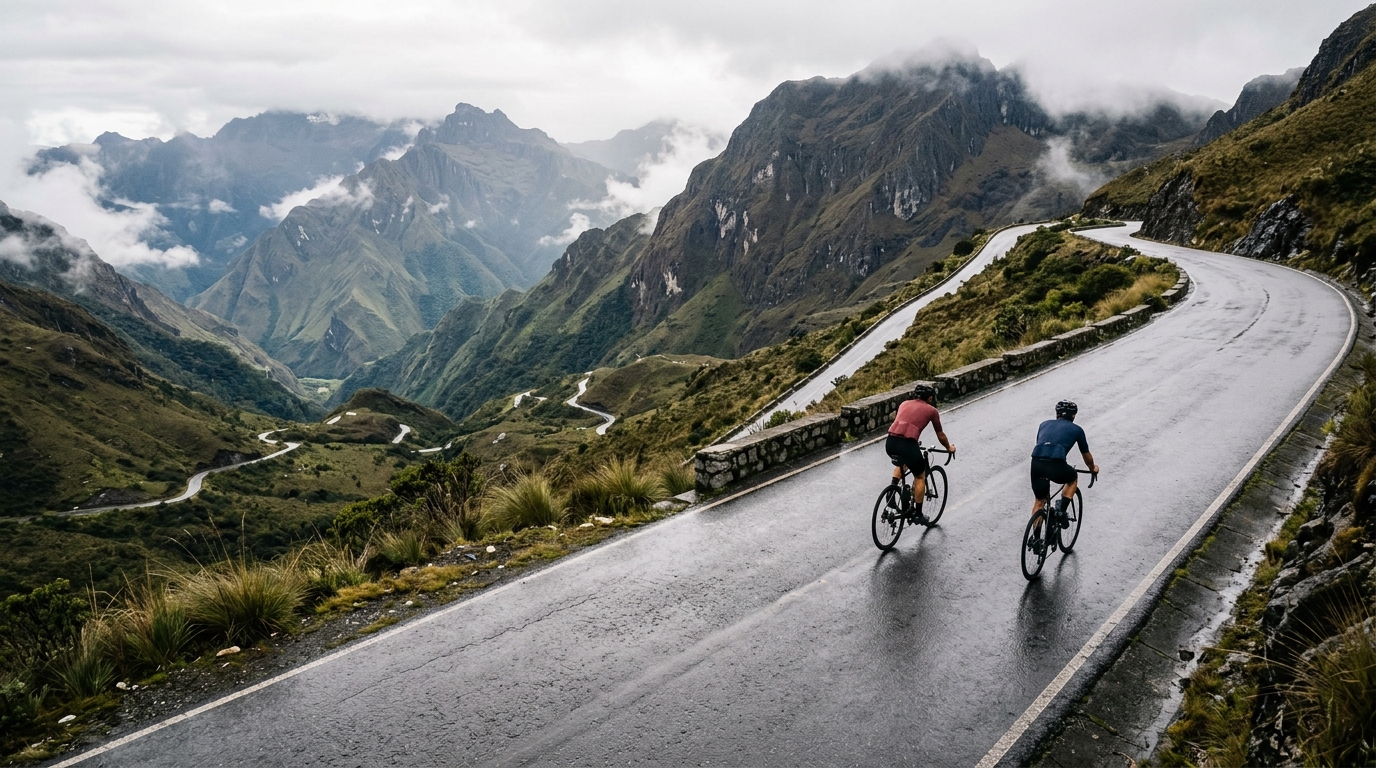
Pico El Águila
A 71.3 km ascent into the Venezuelan Andes that piles up nearly 3,000 metres of relentless, high-altitude climbing on smooth asphalt.
- Distance
- 71.3km
- Climbing
- 2,933m
- Surface
- Asphalt
- Shape
- Point-to-point
The route
Elevation profile
Overview
Pico El Águila is one of the great high-altitude pilgrimages of South American cycling, a 71.3 km point-to-point route carved into the Venezuelan Andes above Mérida. From the first pedal stroke to the last, the road tilts upward, gathering an enormous 2,933 metres of total climbing along the way. There is nothing casual about it: this is a route measured not in flat kilometres but in the slow, thin-aired grind toward the roof of Venezuela. Riders who complete it earn their place in a small club of those who have tested their lungs against one of the continent's most storied mountain roads.
The Route
The route runs 71.3 km in a single direction, a true point-to-point line rather than a loop, meaning every metre gained is metre earned and never given back for free. Over that distance the road climbs a cumulative 2,933 metres, a figure that reframes the whole ride. Rather than a series of discrete efforts separated by recovery, the ascent behaves as one continuous imposition on the legs and the cardiovascular system. The higher you go, the thinner the air becomes, and the páramo landscape of the high Andes opens out around you in stark, windswept grandeur. Pacing is everything here; the riders who suffer least are those who respect the length of the climb from the outset and refuse to burn matches early.
Key Climbs
This route has no individually catalogued climbs, and that absence is itself the defining characteristic. Pico El Águila is not a road punctuated by a handful of named ascents with recovery in between — it is, in effect, a single sustained climb stretched across the full 71.3 km. The 2,933 metres of elevation accumulate steadily rather than in dramatic isolated ramps, which means the challenge is one of endurance and rhythm rather than explosive power. The mountain rewards a diesel engine: a steady, repeatable output held for hours as the altitude climbs and the oxygen thins. If there is a defining feature, it is this unbroken upward tendency, the sense that the road simply refuses to level off.
Terrain & Surface
The entire route is paved in asphalt, which is a genuine mercy given how long and demanding the climb is. A smooth, sealed surface means riders can focus their attention entirely on the effort and the altitude rather than on picking a line through rough ground. There is no gravel, no cobble, no loose surface to sap momentum; the tarmac allows for consistent traction on the climbs and predictable handling wherever the gradient briefly eases. On a route this long, the quality of the road surface is not a minor detail — it is what makes sustained rhythm possible over 71.3 km of near-continuous ascent.
When to Ride
Because Pico El Águila climbs deep into the high Andes, conditions at altitude are the governing factor. The upper reaches are exposed and cold, and weather can shift quickly the higher you go, so choosing a clear, stable day is worth more than any training gain. Aim to start early, giving yourself the full span of daylight to cover 71.3 km at the deliberate pace that nearly 3,000 metres of climbing demands. Riders who leave with plenty of daylight in hand and dress for the cold of altitude will have a far more rewarding day than those caught out late and underprepared near the summit.
Logistics
As a point-to-point route, Pico El Águila requires a little planning that a loop would not: your finish is 71.3 km from your start, so arrange transport or a shuttle rather than assuming you will simply ride back. Carry enough food and fluid to sustain a very long climbing effort, and pack layers for the temperature drop that comes with the elevation gain. The asphalt surface keeps mechanical demands modest, but the altitude and duration mean self-sufficiency and sensible pacing are the real logistical priorities.
Summary
Pico El Águila distils mountain cycling to its purest form: 71.3 km of smooth asphalt climbing that never truly relents, stacking up 2,933 metres of ascent into the thin air of the Venezuelan Andes. It is iconic precisely because it asks one clear question — can you keep climbing? — and answers it with one of the most sustained, high-altitude ascents in South America.