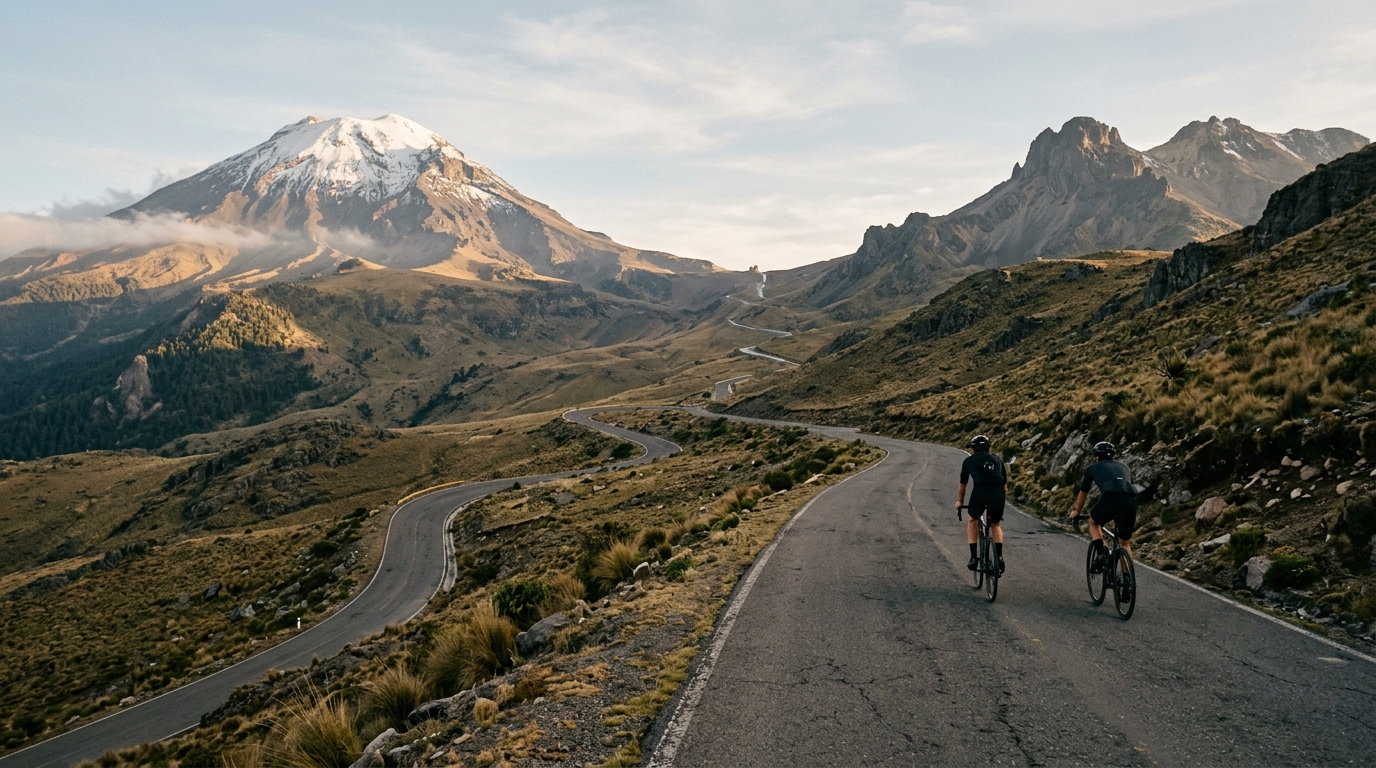
Paso de Cortés
A relentless 26.1 km asphalt climb into the high saddle between two of Mexico's greatest volcanoes.
- Distance
- 26.1km
- Climbing
- 1,295m
- Surface
- Asphalt
- Shape
- Point-to-point
The route
Elevation profile
Overview
Paso de Cortés is one of Mexico's most storied high-mountain rides, a 26.1 km point-to-point ascent that carries you onto the saddle between two of the country's most famous volcanoes. Over its length the route gains 1295 m of elevation, a figure that tells you almost everything you need to know: this is a sustained, uncompromising climb rather than a rolling day out. From the first pedal stroke the road tilts upward and keeps you working, rewarding patience and pacing more than raw power. It is the kind of route that riders build a season around and remember for years afterward.
The Route
Laid out as a single point-to-point line, the ride is refreshingly simple to plan: you start low, you finish high, and everything in between is the mountain. The 26.1 km distance is compact enough to attempt in a morning yet dense enough with vertical gain that no kilometer feels wasted. There is no filler here, no long neutral valley to spin through before the real effort begins. Because it climbs from bottom to top without doubling back, the route has a clean narrative arc — every meter of progress is a meter earned, and the summit at Paso de Cortés is both the literal and emotional destination.
Key Climbs
The defining feature of this route is the climb to Paso de Cortés itself. The named pass gives the ride its identity and its purpose: the entire 26.1 km is essentially one long approach to this high volcanic saddle. With 1295 m of climbing packed into the distance, the ascent is the story, not a supporting act. Riders should treat the whole route as the climb, settling into a rhythm early and resisting the temptation to burn matches on the lower slopes. The summit of Paso de Cortés is the payoff — the moment the road stops rising and the effort of the day finally resolves. Everything before it is preparation; the pass is the prize.
Terrain & Surface
The route is paved in asphalt from start to finish, which shapes the character of the ride in important ways. A consistent sealed surface means you can focus entirely on the climb itself rather than picking lines or managing loose ground, and it makes the descent — should you turn around — a smooth, predictable affair. Asphalt also means standard road tires and gearing are appropriate, though the sheer amount of climbing argues strongly for a compact or wide-range setup. With no surface surprises to contend with, the challenge here is purely one of gravity and endurance: a clean road, a long grade, and 1295 m of gain to manage.
When to Ride
Because this is a high-altitude route topping out at a volcanic pass, conditions at the summit can differ sharply from those at the start. Aim for a clear, settled day and set out early to give yourself the best chance of stable weather and good visibility on the upper slopes. Cooler air at elevation is welcome on a climb of this size, but it can turn quickly, so carry a layer for the top even if the base feels warm. Dry conditions keep the asphalt fast and safe; if you are chasing the finest views of the surrounding volcanic landscape, a bright morning is your friend.
Logistics
As a point-to-point route, the main logistical question is how you return. Plan your transport accordingly — either arrange a pickup at the summit, ride back down the same asphalt road, or build the ascent into a larger loop. Pack for a serious climb: enough water and food to see you through 26.1 km of continuous effort, spares suited to road tires, and clothing that covers the temperature swing between the lower slopes and the exposed pass. Given the altitude and the 1295 m of gain, arrive rested and ride within yourself on the early kilometers.
Summary
Paso de Cortés distills mountain cycling to its essence: 26.1 km, 1295 m of climbing, and one magnificent volcanic pass at the end. Smooth asphalt underfoot and a clean point-to-point profile make it a pure test of climbing legs and pacing. It is a demanding, unforgettable ride — and reaching the pass is a summit worth every meter of the ascent.