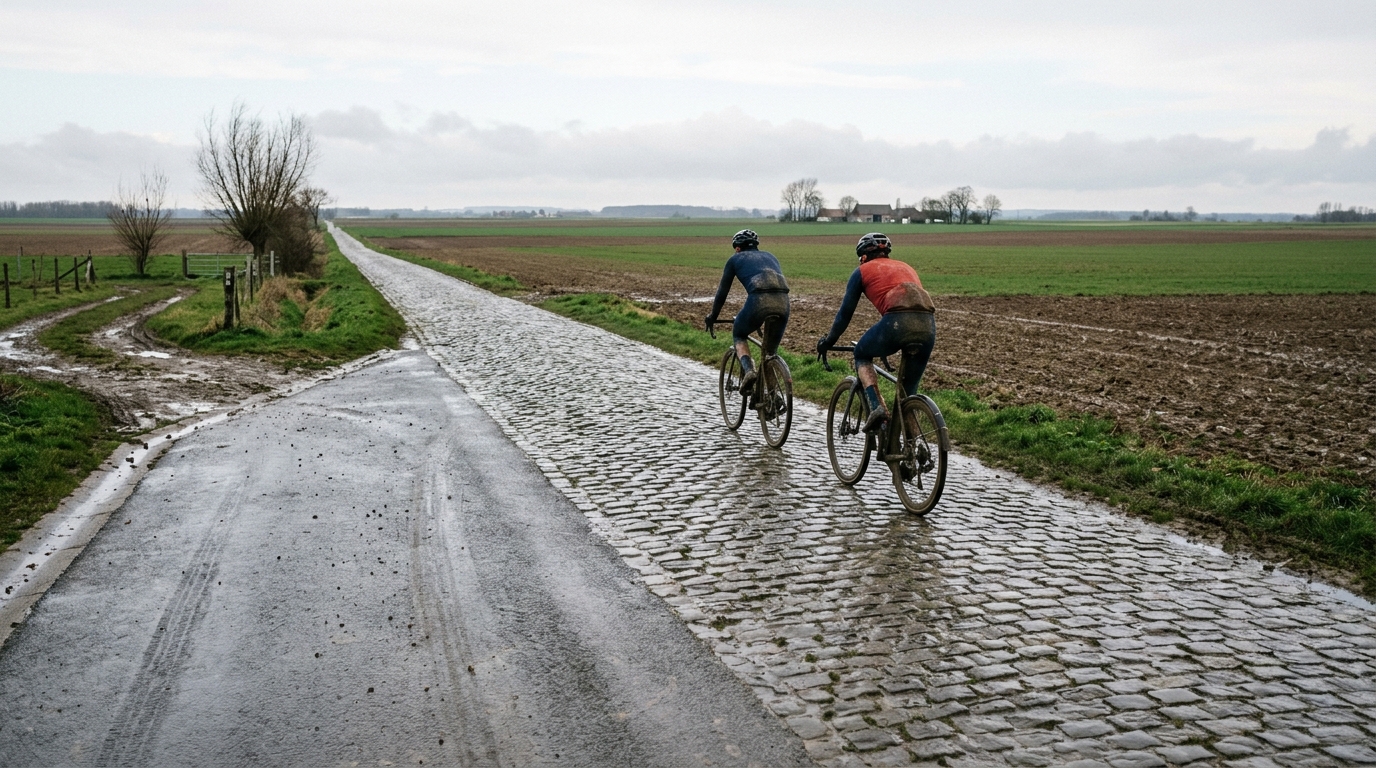
Paris-Roubaix
The Hell of the North: 190.5 km of relentless flat power and brutal cobblestones across Hauts-de-France.
- Distance
- 190.5km
- Climbing
- 1,126m
- Surface
- Mixed
- Shape
- Point-to-point
The route
Elevation profile
Overview
Few names in cycling carry the weight of Paris-Roubaix. This 190.5 km point-to-point route through the Hauts-de-France region is not defined by mountains or soaring passes, but by something rawer: the ground beneath your wheels. With a modest 1126 m of total climbing, the route stays close to flat, yet it earns its fearsome reputation through relentless cobblestones and mixed surfaces that punish riders far more than any col. It is a test of grit, power, and nerve rather than pure climbing legs, and that is precisely what makes it iconic. To ride Paris-Roubaix is to trace a line across northern France that rewards the strong, the steady, and the stubborn.
The Route
Running as a single point-to-point line rather than a loop, Paris-Roubaix carries you across 190.5 km of the Hauts-de-France landscape. The profile is deceptively gentle. Spread across the full distance, the 1126 m of accumulated climbing never assembles into a single dramatic ascent. Instead, elevation trickles in through long, low rises and rolling farmland that barely register on paper but grind on the legs over hours in the saddle. This is a route to be measured in effort rather than altitude. Because it is point-to-point, planning your start and finish logistics matters more than on a route that returns you to the car, and the linear shape gives the ride a genuine sense of journey from one place to another.
Key Climbs
There are no catalogued climbs on Paris-Roubaix, and that absence is the whole story. This is not a route that lives or dies by its ascents. Its defining feature is the surface: the cobbles. Where other iconic rides hand you a summit to conquer, Paris-Roubaix hands you the pavé, sections of ancient, jarring stone that rattle the bike, numb the hands, and demand a completely different kind of strength. The challenge here is flat power and cobbled endurance, the ability to hold a big effort over rough ground while staying upright and smooth. Rather than counting climbs, you count the cobbled sectors and the kilometres, pacing your energy across the whole 190.5 km rather than saving it for a single hill.
Terrain & Surface
The surface on Paris-Roubaix is mixed, and that mix is the heart of the experience. Stretches of smooth tarmac let you build rhythm and speed, only to give way to the notorious cobblestones that break the flow and test both bike and body. The rolling terrain, accounting for that gradual 1126 m of climbing, keeps the effort honest without ever tipping into steep gradients. Riders should expect constant transitions, from fast paved sections to bone-shaking pavé and back again. Tyre choice, tyre pressure, and a relaxed grip on the bars all matter enormously here. This is a route where equipment and technique count as much as fitness, and where reading the surface ahead becomes second nature.
When to Ride
Paris-Roubaix rewards dry, settled conditions. On mixed surfaces, and especially over cobbles, wet weather transforms an already demanding ride into a genuinely treacherous one, with stone turning slick and unpredictable. Aim for a day with firm, dry ground to get the most from the route and to keep the cobbled sections manageable. The flat-to-rolling profile means you are exposed to the open northern landscape for long stretches, so a calmer, clearer day makes the 190.5 km far more enjoyable. Give yourself enough daylight to cover the full point-to-point distance at a steady, sustainable pace.
Logistics
Because Paris-Roubaix is a point-to-point route rather than a loop, your logistics need a little forethought. You finish 190.5 km from where you began, so plan transport at both ends, whether that means arranging a shuttle, a second vehicle, or public transport to close the gap. Set your bike up for the mixed surface, prioritising resilience and comfort over outright lightness, and carry the tools and spares to handle the punishment the cobbles deliver. Fuel and hydration strategy matter across such a long, sustained effort, so plan your stops with the full distance in mind.
Summary
Paris-Roubaix is cycling stripped to its rawest form: 190.5 km of flat and rolling terrain, 1126 m of gentle climbing, and a mixed surface whose cobblestones define everything. There are no climbs to tick off here, only the pavé to survive and the distance to conquer. For riders drawn to grit over gradient, it remains one of the most iconic routes in the sport.