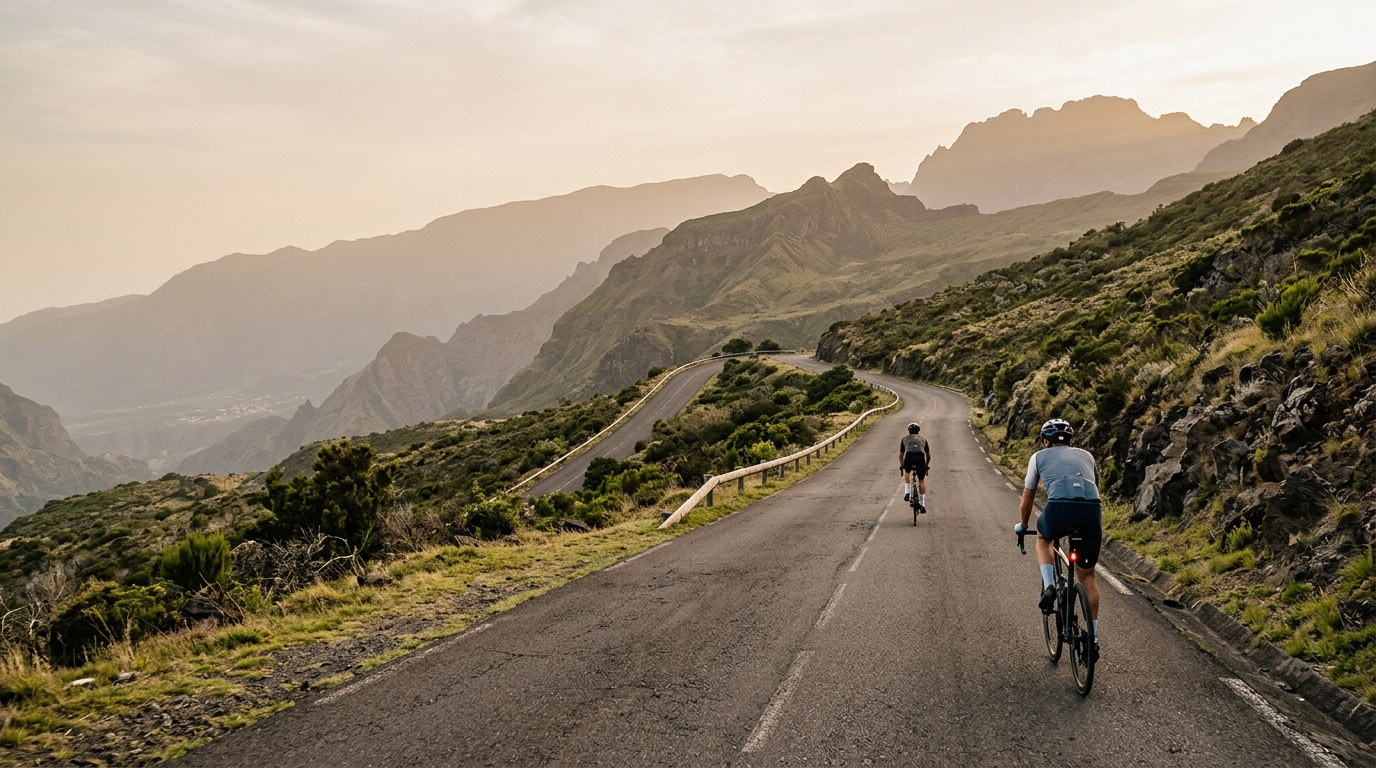
Maïdo
A relentless 30.2 km point-to-point wall of asphalt that climbs 2140 m from the coast of Réunion to a sky-scraping volcanic belvedere.
- Distance
- 30.2km
- Climbing
- 2,140m
- Surface
- Asphalt
- Shape
- Point-to-point
The route
Elevation profile
Overview
Maïdo is one of the great single-purpose climbs of the cycling world, a 30.2 km point-to-point ascent that packs 2140 m of vertical gain into a single upward march across the island of Réunion. There is no loop here, no gentle return leg, no place to hide: from the moment you leave the coastal plain the road tilts up and simply refuses to relent until you reach the belvedere at the top. It is the kind of route riders travel across oceans to test themselves against, a ribbon of asphalt that gains altitude faster and longer than almost anywhere else in the Indian Ocean, and it wears its reputation as a rite of passage for anyone who takes climbing seriously.
The Route
The defining fact of Maïdo is its shape: a straight line drawn from low to high. Over 30.2 km the road ascends 2140 m, an average that keeps the gradient honest and the legs burning for hours. Because it is point-to-point, the ride has a clear narrative arc — a beginning at the bottom, a middle where the air thins and the vegetation changes, and an unambiguous, celebratory end at the summit. There is no descent to recover on, no rolling respite to reset the rhythm. You settle into a cadence early, you protect it, and you carry it all the way up. That purity is exactly what makes the route iconic; it removes every variable except the rider and the mountain.
Key Climbs
This route has no separately catalogued climbs because it does not need them — the entire 30.2 km is the climb. The defining feature of Maïdo is sustained, uninterrupted vertical work: 2140 m of gain delivered as one continuous effort rather than a series of named cols stitched together. The challenge is not a single decisive ramp but the sheer duration of the ascent, the way the road keeps rising long after most climbs would have crested. Pacing becomes everything. Riders who go out hard on the lower slopes pay for it in the upper reaches, where fatigue and altitude compound. Treat the whole road as one long, unbroken climb and manage your effort as a single ascent from bottom to top.
Terrain & Surface
Maïdo is paved end to end in asphalt, giving the route a smooth, predictable surface beneath the tyres for its full 30.2 km. That consistency matters on a climb this long: with no cobbles, gravel, or broken sections to break your rhythm, the road lets you focus entirely on the relentless gradient rather than on threading a line. The tarmac rewards a steady seated cadence and efficient power delivery, and it makes the summit descent — for those returning the way they came — fast and flowing. Good asphalt on a 2140 m ascent is a gift, and Maïdo delivers it consistently from the coast to the belvedere.
When to Ride
Because the route gains so much altitude, conditions can differ dramatically between the bottom and the top. Aim to start early, before the heat of the day builds on the lower slopes, and dress so you can adapt as you climb into the cooler air near the summit. Clear mornings tend to offer the most reliable riding and the best chance of the panoramic reward that awaits at the top, so plan your effort around good visibility and a settled sky.
Logistics
As a point-to-point route, Maïdo asks a little planning. Decide in advance whether you will descend back down the same asphalt or arrange transport at the summit, and stage your food and fluids for a long, sustained effort — 2140 m of climbing over 30.2 km is a serious outing that can take hours depending on your pace. Carry enough to stay fuelled all the way to the top, and bring layers for the temperature drop at altitude. Beyond that, the logistics are refreshingly simple: one road, one direction, up.
Summary
Maïdo distils cycling to its most elemental form — a rider, a smooth 30.2 km of asphalt, and 2140 m of unbroken climbing to the summit. There are no catalogued climbs to break the effort into chapters and no return leg to soften the challenge; there is only the long, honest ascent. That simplicity is precisely why it endures as one of Réunion's most iconic rides.