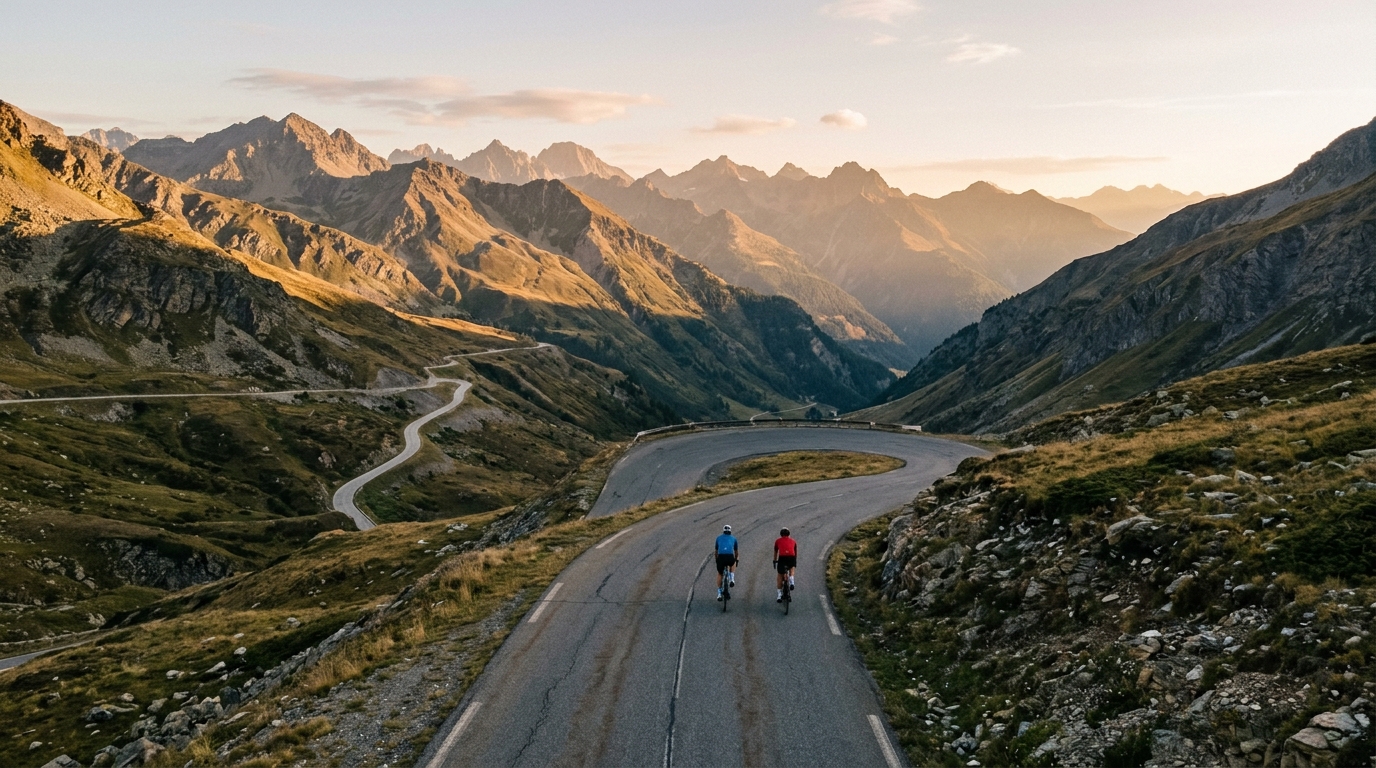
La Marmotte
One of cycling's most punishing single-day rides: 162.8 km and 5,706 m of climbing across the great passes of the French Alps.
- Distance
- 162.8km
- Climbing
- 5,706m
- Surface
- Asphalt
- Shape
- Point-to-point
The route
Elevation profile
Overview
La Marmotte is one of the most revered rides in the French Alps, a point-to-point odyssey that packs 5,706 m of vertical gain into 162.8 km. It is a route defined not by distance but by relentless verticality: over a single day, riders climb the height of the world's tallest peaks and then some, linking together a sequence of legendary alpine passes into one continuous, unforgiving line. For amateur cyclists it functions as a rite of passage, a benchmark against which a season of training is measured, and a route whose name alone signals suffering earned honestly. Few rides compress so much iconic climbing into so compact a course, and fewer still finish where La Marmotte finishes.
The Route
The route runs point-to-point rather than looping back on itself, meaning every metre of the 162.8 km carries you toward a distant, decisive conclusion. There is no gentle return leg, no flat run-in to recover on. Instead the course threads a chain of mountain cols, stringing together valley floors and high passes so that the profile reads as a saw-toothed wall of ascent and descent. The 5,706 m of total climbing is not front-loaded or saved for a single showpiece; it is distributed across successive major climbs, each demanding its own reserve of legs and resolve. By design, the hardest metres come late, when fatigue has already stripped away any margin.
Key Climbs
La Marmotte's reputation rests on the marquee climbs it passes. Early in the day the road tackles the Col du Glandon and the neighbouring Col de la Croix de Fer, twin passes whose winding gradients set the tone and begin draining the legs long before the halfway point. From there the route builds toward the Col du Galibier, one of the great high passes of the Alps, whose thin air and exposed upper slopes have humbled generations of riders. The finale is the most famous of all: the ascent to Alpe d'Huez, the switchbacking climb that has become shorthand for alpine cycling drama. Reaching it after everything that has come before is what gives La Marmotte its mythic status. Each of these climbs would headline a lesser ride; stitched together, they make one of the sport's defining tests.
Terrain & Surface
The entire route is ridden on asphalt, so the challenge is purely one of gradient, distance and altitude rather than loose or broken ground. Sealed roads mean riders can commit fully to pacing and gearing decisions without the added variable of surface grip. That said, asphalt in the high mountains brings its own character: long tarmac descents between the climbs demand focus and bike-handling confidence, and the road surface heats and cools with the altitude. There is no gravel, no cobble, no off-road interruption — just kilometre after kilometre of mountain blacktop rising and falling through the Alps.
When to Ride
Because La Marmotte crosses high alpine passes, it is best attempted in the warmer months when the roads to the highest cols are reliably clear and open. High-altitude climbs like the Galibier are exposed and can be cold even in summer, so conditions on the upper slopes should always be checked before setting out. Aim for settled weather: the combination of long climbs, fast descents and thin air is far more manageable in stable, dry conditions than in mountain storms.
Logistics
The point-to-point format is the single biggest logistical consideration. Because you finish at Alpe d'Huez rather than back at the start, plan transport, accommodation and support with the split between start and finish in mind. With 5,706 m of climbing over 162.8 km, fuelling and hydration strategy matter enormously — the effort is sustained over many hours, and the late climbs punish anyone who under-fuels early. Gearing suited to prolonged steep ascents, layers for the cold high passes, and a plan for the long descents will all repay the effort.
Summary
La Marmotte earns its iconic reputation the hard way: 162.8 km, 5,706 m of climbing, and a point-to-point line that chains the Glandon, the Croix de Fer, the Galibier and the summit finish at Alpe d'Huez. On asphalt throughout, it is a pure test of climbing endurance and one of the great days out in the French Alps.
Climbs on this route
Alpe d'Huez
HCTwenty-one numbered hairpins climb out of the Romanche valley to a ski station that has hosted the Tour de France more often than any other summit finish.
Col du Galibier
HCFrom Briançon over the Col du Lautaret to the Galibier summit - 34 km and almost 2000 m of climbing through the heart of the French Alps.
Col du Mollard
HC11.9 km at 8.68% average with a savage 35.19% maximum gradient — the Col du Mollard is a genuine HC climb that demands careful pacing and low gearing.
Col du Glandon
Cat 17.9 km at 9.6% average with a 25.5% maximum — the Col du Glandon is a Category 1 brute in the French Alps that demands disciplined pacing from the first pedal stroke.
Col de la Croix de Fer
HC28.8 km at 5.48%, rising from 484 m to 2061 m — an HC beast that trades short ramps for relentless, saddle-and-swell endurance.
Col de Sarenne
Cat 18.7 km at 7% average with a savage 26% max gradient — Col de Sarenne is a Category 1 brute hiding in Alpe d'Huez's shadow. Here's how the climb actually unfolds.
Col du Chaussy
HC10.1 km at 10.33% average gradient with a savage 36.47% maximum pitch. Col du Chaussy is an HC climb that demands respect from the first pedal stroke.