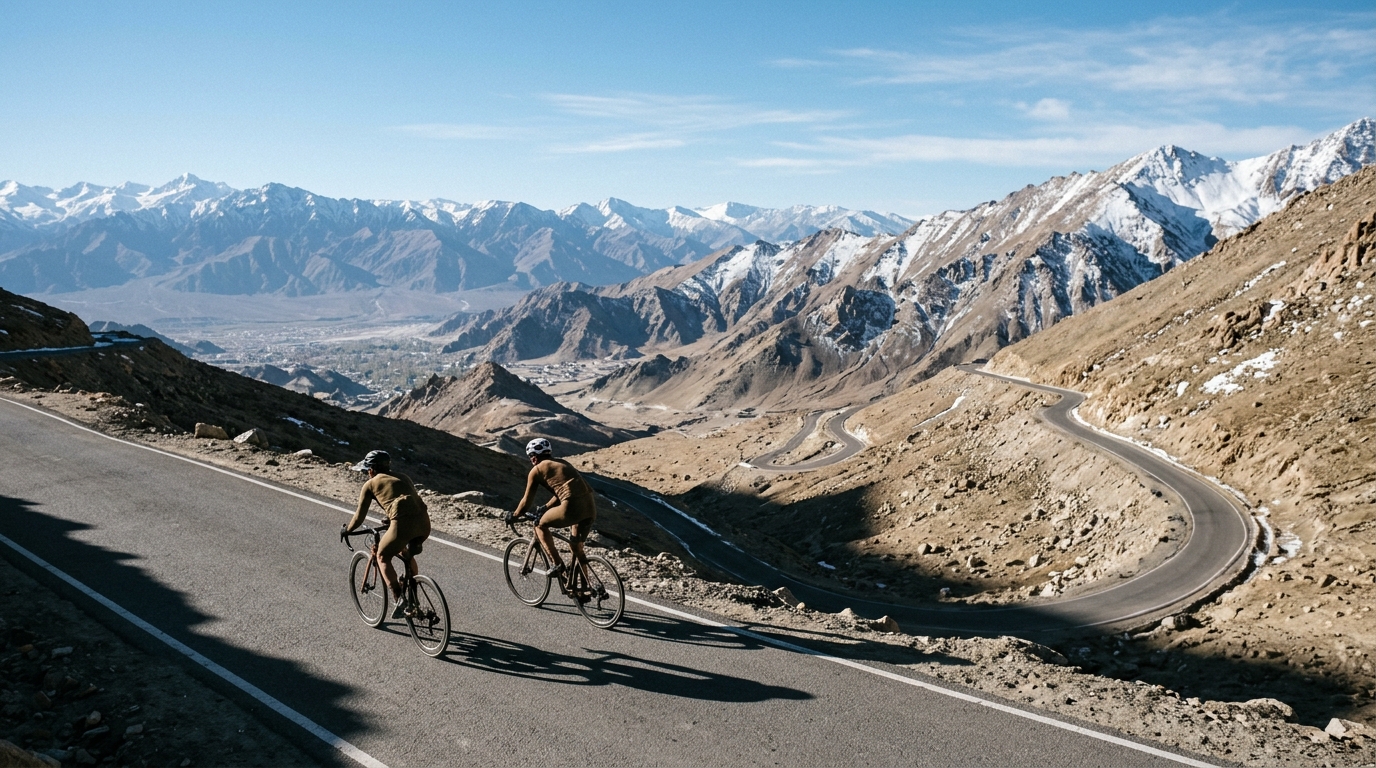
Khardung La from Leh
A relentless 30.7 km asphalt climb out of Leh that hauls you nearly 2,000 vertical metres to the thin, wind-scoured air of Khardung La.
- Distance
- 30.7km
- Climbing
- 1,986m
- Surface
- Asphalt
- Shape
- Point-to-point
The route
Elevation profile
Overview
Few road rides in the world carry the mystique of the ascent from Leh to Khardung La. In just 30.7 kilometres, this point-to-point route lifts you 1,986 metres from the streets of Ladakh's high-desert capital to one of the most celebrated passes in the Indian Himalaya. It is a ride defined by a single, uncompromising idea: go up, and keep going up. There are no rolling reprieves, no gentle valley miles to warm the legs — only a long, sustained march into ever-thinner air. That purity is exactly what makes it iconic. Every metre you turn over on the pedals is a metre earned against gravity and altitude, and the reward is a summit that feels less like a road and more like the roof of the world.
The Route
The route runs from Leh directly to Khardung La, a clean 30.7 km line with a single, overriding objective. Because it is point-to-point rather than a loop, the entire distance is oriented toward the climb — you finish where the road tops out, not back where you began. The 1,986 metres of total climbing are packed into that span, which tells you everything about the character of the ride: this is not a route that rewards freewheeling. From the moment you leave Leh, the road tilts upward and the accumulated vertical builds relentlessly toward the pass. Plan your logistics around a one-way effort, and treat the summit as both the physical and emotional terminus of the day.
Key Climbs
The defining feature of this route is the climb to Khardung La itself — there is really no other way to describe it. The pass is the reason the ride exists, and the entire 30.7 km is essentially one continuous approach to it. With 1,986 metres of gain compressed into the distance, the ascent never lets up, and the effort is as much about managing altitude as it is about managing the gradient. Pacing is everything: the thin air punishes anyone who goes out too hard, and the summit only yields to patience. Reaching Khardung La under your own power is the singular achievement this route offers, and it is the memory riders carry away.
Terrain & Surface
The entire route is paved with asphalt, which is a meaningful part of its appeal. Rather than fighting loose gravel or broken track, you can commit fully to the rhythm of the climb, letting a smooth road surface translate every watt into forward and upward progress. That said, asphalt in this environment does not mean easy — the tarmac simply removes surface uncertainty so the mountain itself becomes the challenge. A road bike or an all-road setup with sensibly low gearing is well suited here; save your energy for the altitude and the gradient rather than for wrestling with the ground beneath your tyres.
When to Ride
High mountain routes like this are best tackled in the warmer, drier stretch of the year, when the road to the pass is clear and conditions on the exposed upper slopes are at their most forgiving. Start early to make the most of stable morning weather and to leave ample margin for the slow, deliberate pace that altitude demands. Layers are essential: the temperature at the top of a 1,986-metre climb can be a world away from the conditions in Leh below.
Logistics
Base yourself in Leh, the natural starting point and a place to acclimatise before attempting the climb. Because the route is point-to-point, arrange onward transport or a plan for the descent in advance rather than assuming a simple round trip. Carry enough food and water for a sustained effort, since the ride is long on climbing and offers few chances to recover. Above all, respect the altitude — give yourself days in Ladakh's high country before you go, and let your body adapt before you point the front wheel toward Khardung La.
Summary
Khardung La from Leh distils road cycling to its most elemental form: 30.7 km, 1,986 metres of climbing, smooth asphalt underfoot, and a legendary Himalayan pass waiting at the top. It is a ride that asks for patience, respect for altitude, and steady legs — and repays all three with a summit that ranks among the great cycling achievements in India.