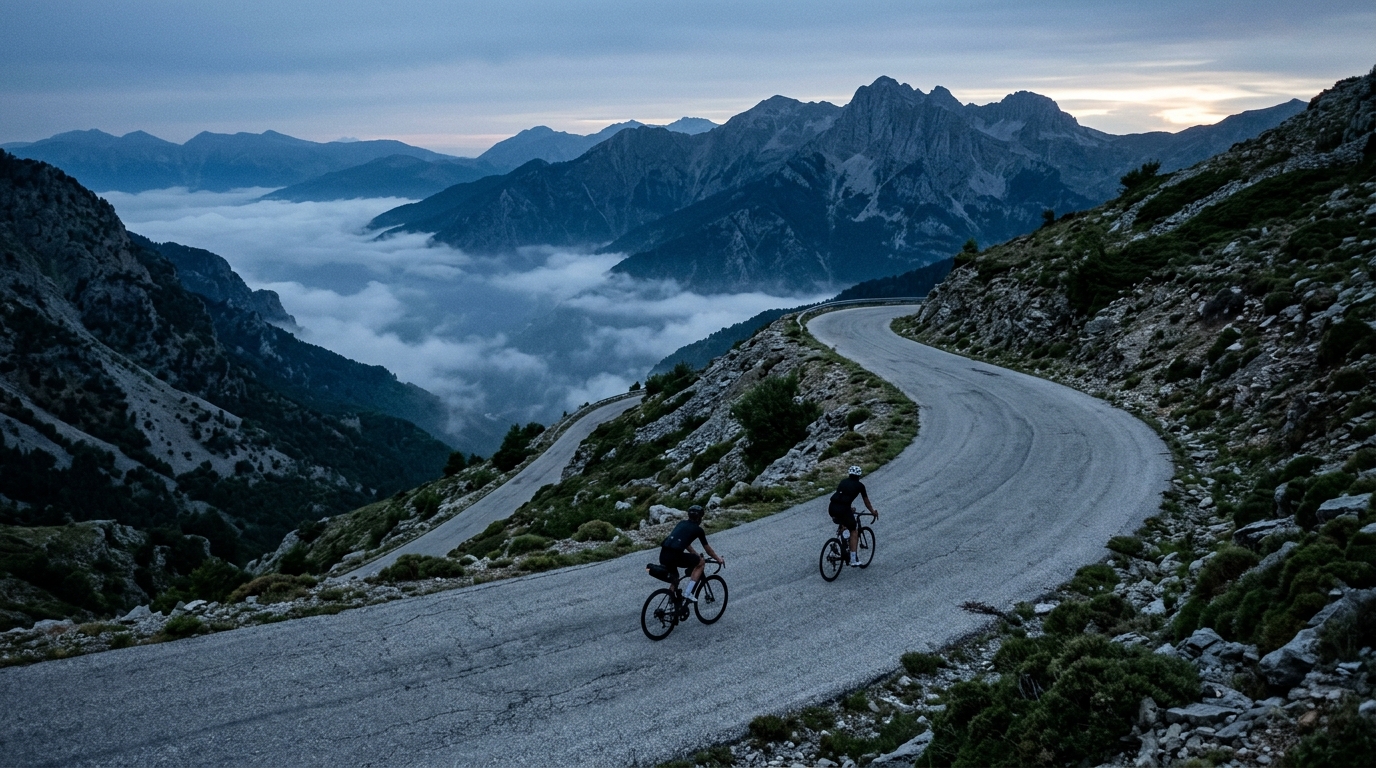
Katara Pass
A 68.3 km asphalt traverse over the storied Katara Pass, threading the raw heart of Greece's Pindus Mountains.
- Distance
- 68.3km
- Climbing
- 1,239m
- Surface
- Asphalt
- Shape
- Point-to-point
The route
Elevation profile
Overview
The Katara Pass is one of the great mountain crossings of the Greek mainland, a 68.3 km point-to-point ride that carries you over the spine of the Pindus Mountains. This is not a loop to be nibbled at and repeated; it is a linear journey with a beginning and an end, a route that commits you to a single, sustained arc across the range. Over its length you gather 1,239 metres of climbing, a figure that speaks to a road that rises purposefully rather than a course of endless punchy repeats. The Pindus is the wild backbone of Greece, a landscape of deep valleys, forested slopes and stone villages, and the Katara Pass has long been the thread that stitches one side of it to the other. To ride it is to trace a line that traders, shepherds and travellers have followed for generations, now smoothed into a rideable ribbon of asphalt.
The Route
As a point-to-point, the Katara Pass rewards planning and commitment. The 68.3 km distance is substantial but far from unmanageable, and the 1,239 m of total climbing is distributed across the traverse rather than crammed into a single wall. The route's defining rhythm is the long approach to and crossing of the pass itself, the road gathering height as the valley narrows and the mountains close in around you. Because it does not double back on itself, every kilometre carries you into new terrain, the scenery shifting as you climb toward the high point and then release down the far side. It is a route built for a full day out, where the effort of the ascent is answered by the reward of the crossing.
Key Climbs
The Katara Pass is the route, and the route is the Katara Pass. This is the single defining feature around which everything else is arranged. The climb to the pass is the heart of the ride, the reason the 1,239 m of elevation exists and the moment the whole journey builds toward. Threading the highest reaches of the Pindus, the Katara Pass is a crossing that has earned its reputation through geography alone, the natural gateway over a range that otherwise walls off one region from the next. Reaching it on a bike is a genuine achievement, the sort of high point that stays with you long after the descent has faded into memory.
Terrain & Surface
The entire route runs on asphalt, which shapes the character of the ride from start to finish. There is no gravel to unsettle your line, no cobbles to hammer your hands, and no loose surface to force compromise on your equipment. The sealed road lets you focus purely on the terrain beneath the tarmac, on the gradient and the rhythm of the climb rather than on picking a way through rough ground. On the descents, the asphalt allows you to carry speed with confidence and to enjoy the flowing lines the mountain road offers. Standard road tyres are all you need; this is a route for a road bike ridden well.
When to Ride
Because the Katara Pass climbs high into the Pindus, timing matters. The warmer months of the year offer the most reliable conditions for a high mountain crossing, when the road is clear and the weather at altitude is at its most forgiving. Mountain weather is always changeable, so carry layers for the temperature drop on the pass and the wind chill of the descent, even on a day that starts warm in the valley.
Logistics
The point-to-point format is the key logistical consideration. Because you finish in a different place than you start, plan your transport in advance, whether that means arranging a shuttle, a pickup or an onward connection from the far end of the route. Carry enough food and water for a full day in the mountains, since resupply in the remote heart of the Pindus should never be assumed. A road bike in good order, spare tubes and the ability to handle a long climb are the essentials.
Summary
The Katara Pass distils everything compelling about mountain cycling into a single 68.3 km line: a committing point-to-point traverse, 1,239 m of honest climbing, smooth asphalt underfoot and an iconic high crossing at its core. It is a route that asks for a full day and gives back a genuine sense of having crossed something, the true reward of the Pindus Mountains.