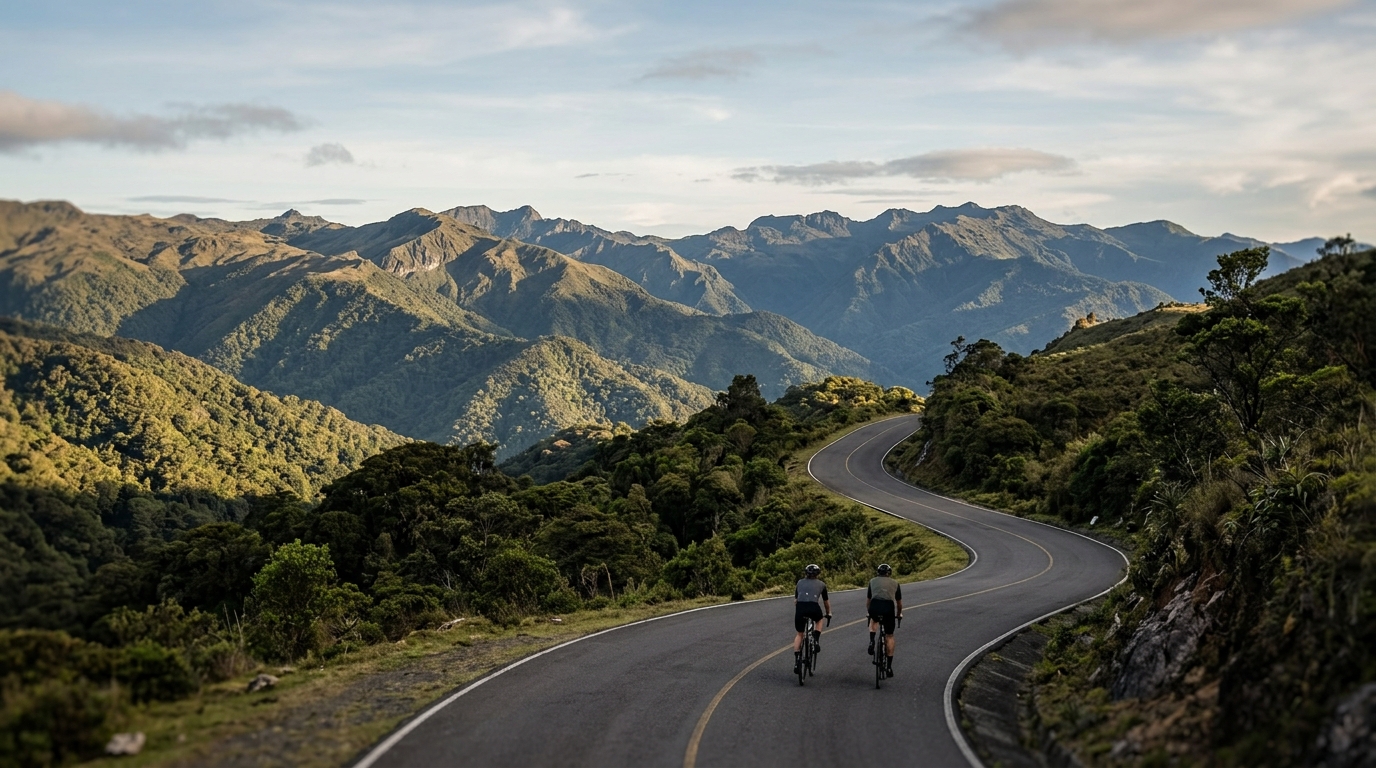
Cerro de la Muerte
A 111 km point-to-point across Costa Rica's Talamanca highlands, stacking 3,042 m of relentless asphalt climbing.
- Distance
- 111km
- Climbing
- 3,042m
- Surface
- Asphalt
- Shape
- Point-to-point
The route
Elevation profile
Overview
Cerro de la Muerte is one of Costa Rica's most storied rides, a 111 km point-to-point that threads through the rugged Talamanca highlands. The name alone commands respect, and the numbers back it up: over the full distance you accumulate 3,042 m of climbing, a figure that puts this route firmly in the realm of the ambitious. There are no gimmicks here, no gravel sectors or cobbled ramps to break the rhythm. It is simply road, sky, and a long, honest test of legs and lungs. Riders come for the sustained effort and the sense of crossing a landscape rather than looping around one, and they leave with a story worth telling.
The Route
This is a true point-to-point, meaning you finish somewhere other than where you started. Across 111 km the road carries you steadily upward and onward, banking 3,042 m of elevation gain along the way. That ratio, roughly 27 vertical metres for every kilometre, tells you what to expect: this is not a flat transfer between towns but a continuous engagement with the terrain of Talamanca. Because it runs from A to B, planning matters. You commit to the full distance once you begin, with the reward of forward progress through changing country rather than the repetition of an out-and-back.
Key Climbs
This route carries no individually catalogued climbs, and that absence is itself the defining feature. Rather than a handful of famous named ascents to tick off, Cerro de la Muerte delivers its 3,042 m of gain as one long, integrated effort woven into the fabric of the road. There is no single wall to fear and no summit sign to sprint for. Instead the challenge is cumulative and psychological: metres stack up quietly, kilometre after kilometre, until the total becomes formidable. Pacing is everything. Riders who treat the whole 111 km as the climb, metering their energy across the full point-to-point, fare far better than those hunting for a decisive pitch that never announces itself.
Terrain & Surface
The entire route runs on asphalt, a consistency that shapes the whole experience. There are no surface changes to manage, no switching between tarmac and dirt, and no need for wide tyres or defensive line choices. A road bike is entirely at home here. Smooth pavement means your attention stays on rhythm, gearing, and the accumulating gradient rather than on traction. Over 3,042 m of climbing, that predictability is a genuine advantage: every watt goes into forward motion, and descents can be ridden with confidence. The unbroken asphalt underscores the route's character as a pure road-cycling proposition.
When to Ride
As with any long highland route, timing your effort to the day matters more than to any calendar rule. Aim to start early so the bulk of the 111 km and its 3,042 m of climbing are behind you before the heat and weather of the afternoon build. Highland conditions can shift quickly, so pack for both warmth on the exposed upper stretches and comfort lower down. Give yourself a generous window: at this distance and elevation gain, rushing the back half is where rides unravel. A patient, well-fuelled schedule turns a daunting profile into an achievable, memorable day.
Logistics
Being a point-to-point, Cerro de la Muerte demands a little more forethought than a loop. You will need to arrange how you get back from the finish, whether by pre-positioning a vehicle, coordinating a shuttle, or planning onward travel from the end point. Carry enough food and fluid to sustain a full day of climbing, since 3,042 m of gain burns through reserves faster than the distance alone suggests. With everything on asphalt, a standard road setup and spares suffice. Confirm your start and finish logistics before you roll out so the ride itself can stay focused on the road ahead.
Summary
Cerro de la Muerte earns its iconic status through honesty rather than spectacle: 111 km of asphalt, 3,042 m of climbing, and a single sustained line across the Talamanca highlands. With no catalogued climbs to distract you, the whole route becomes the challenge, rewarding patience, pacing, and preparation. Plan your point-to-point logistics, start early, and let the road carry you.