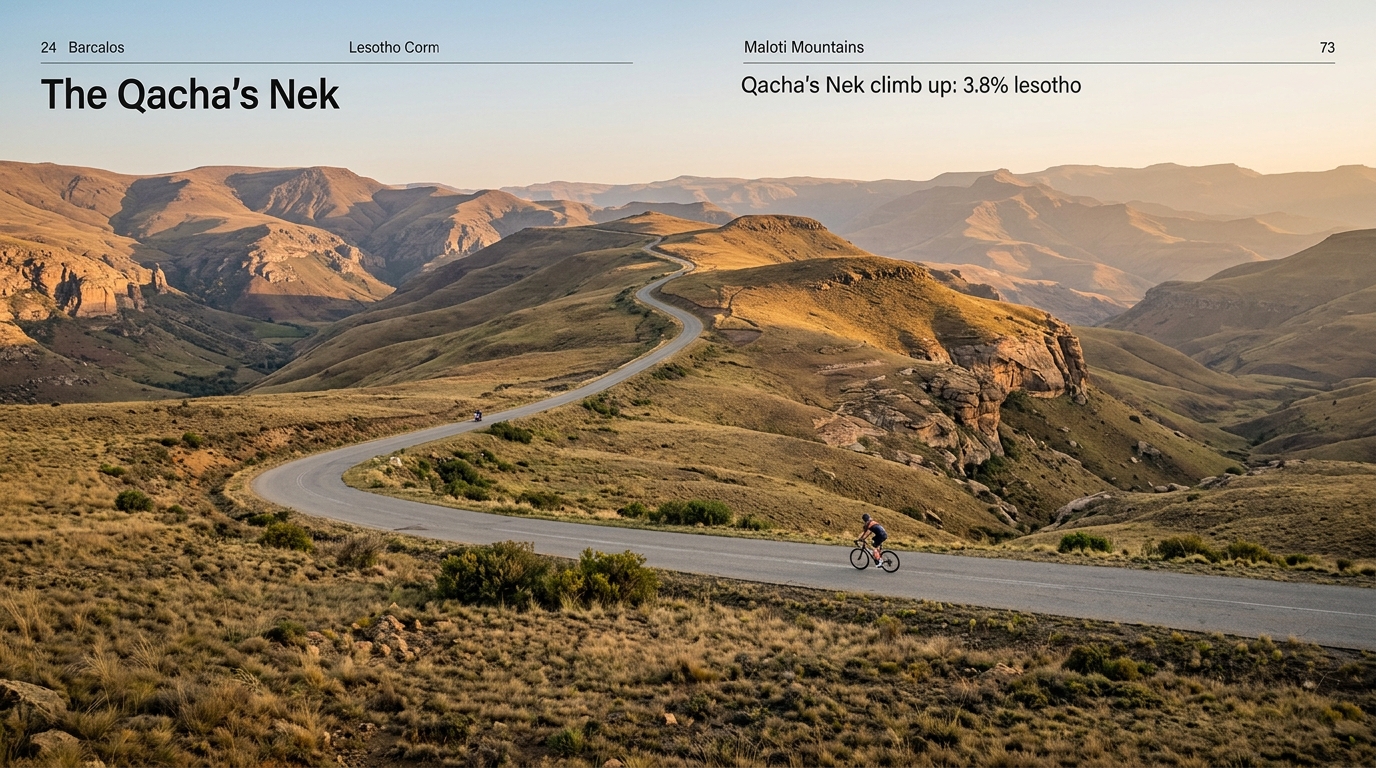
Qacha's Nek
A measured profile of the Qacha's Nek cycling climb, with pacing and gearing notes for its 13.7 km rise at 3.81%.
- Length
- 13.7km
- Avg
- 3.8%
- Max
- 8.9%
- Summit
- 1,995m
- Ascent
- 506m
The climb
Gradient profile
Qacha's Nek cycling climb profile
Qacha's Nek is a long, controlled effort rather than a brutal wall. The climb runs for 13.7 km, rises from 1475 m to 1995 m, and averages 3.81%. On paper, that makes it a category 3 climb, but the useful riding lesson is in how those numbers interact: the average is moderate, the elevation gain is meaningful, and the maximum gradient of 8.86% is steep enough to punish anyone who treats the early slopes like free speed.
The listed profile gives 506 m of total ascent, while the start and summit elevations imply a net rise of 520 m. Either way, the practical read is the same: this is a climb that trends upward consistently enough to demand pacing discipline, without being defined by sustained double-digit ramps.
How the gradient unfolds
With an average gradient of 3.81%, Qacha's Nek should feel rideable for long stretches, especially compared with shorter, sharper climbs. The danger is that this kind of grade often encourages over-gearing. It is easy to sit on a big gear, keep the speed high, and only realise too late that the climb has been quietly accumulating fatigue.
The max gradient of 8.86% changes the ride. Even if the climb is not steep overall, any ramp near that figure will force a clear decision: either shift early and keep the effort under control, or grind through it and pay for the torque cost later. Because the climb is 13.7 km long, those steeper sections should be treated as pacing interruptions, not attack points, unless the goal is a maximal effort.
Pacing strategy
The best approach is to ride the opening section below threshold, even if the gradient feels manageable. On a climb with this average, speed can be deceptive. Holding a smooth aerobic tempo early keeps enough headroom for the steeper pitches and the final push toward 1995 m.
If riding by power, anchor the effort around a sustainable climbing target rather than reacting to every change in slope. Use the steeper ramps as brief rises above baseline, then deliberately settle back. If riding by feel, the correct sensation is firm but controlled breathing, with no need to force cadence just to hold speed. For help setting effort zones, see /glossary/ftp.
Gearing notes
Qacha's Nek does not demand extreme climbing gearing for a well-prepared rider, but it does reward having a lower option available. The 8.86% maximum gradient is the reason. A setup that lets you stay seated and maintain cadence through the steepest ramps will be faster over the full 13.7 km than muscling a harder gear whenever the road kicks up.
The simplest rule is to gear for the maximum gradient, not the average. The average tells you the climb is manageable. The maximum tells you where the damage can happen.