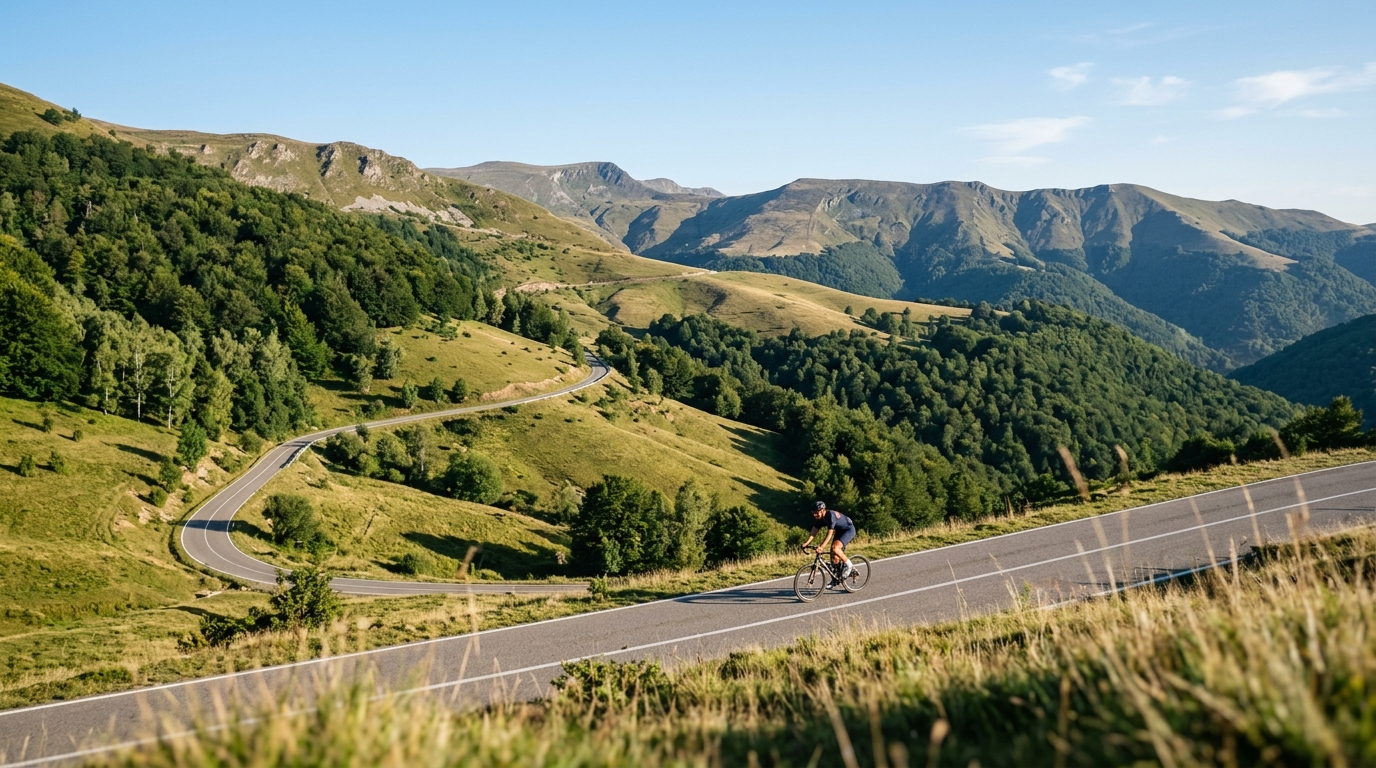
Prislop Pass
Prislop Pass cycling climb is a long, controlled category 2 ascent in RO: 18.4 km at 3.75%, topping out at 1,405 m.
- Length
- 18.4km
- Avg
- 3.8%
- Max
- 5.5%
- Summit
- 1,405m
- Ascent
- 676m
The climb
Gradient profile
Prislop Pass cycling climb profile
Prislop Pass is a category 2 climb that rewards control more than aggression. At 18.4 km with an average gradient of 3.75%, it is long enough to punish over-pacing, but not steep enough on paper to demand repeated out-of-saddle efforts or survival gearing for most riders.
The climb starts at 713 m and reaches 1,405 m, giving 692 m of net elevation gain. The source data also lists 676 m of total ascent, which is close enough to point toward the same practical conclusion: this is a long, moderate pass where the main difficulty is duration, not violent gradient.
How the gradient rides
The key number is not just the 3.75% average. It is the relationship between that average and the 5.54% maximum gradient. A climb with a modest average but a much higher maximum can hide repeated ramps that force big power spikes. Prislop Pass does not look like that from the available data. The maximum gradient sits only moderately above the average, which suggests a climb that should be ridden with steady pressure rather than constant gear changes and accelerations.
That does not make it easy. An 18.4 km ascent at this gradient still asks for patience. The danger is that the opening feels manageable, so riders drift above sustainable power without noticing. On a climb this long, that small early overreach usually shows up later as fading cadence and unnecessary torque in the final kilometres.
Pacing strategy
Ride Prislop Pass as a controlled aerobic climb. The best approach is to settle early, keep the effort below the point where breathing becomes ragged, and resist the temptation to chase speed on the gentler parts. Because the maximum gradient is 5.54%, the smartest pacing is likely smooth and even, not stochastic.
If using power, anchor the effort around your sustainable climbing range rather than treating each steeper pitch as a reason to surge. If you need to benchmark that effort, use /glossary/ftp as the reference point or estimate it with /tools/ftp-estimator before building a pacing target.
Gearing notes
Prislop Pass should not require extreme low gearing based on the listed gradients, but the length makes cadence management important. Choose a setup that lets you stay seated and keep pressure smooth when the road approaches its maximum gradient. The goal is not to survive a wall, but to avoid grinding for too long.
For stronger riders, standard climbing gearing may be enough. For endurance riders or anyone carrying fatigue, having one easier gear than expected is still useful. On an 18.4 km climb, the cost of slightly lower gearing is small, while the cost of being over-geared late is usually much higher.