Climb library · Indonesia
Cycling climbs in Indonesia
Indonesia rewards the patient cyclist with a compact but formidable catalogue of two climbs, carved into the country's restless volcanic landscape. What it lacks in quantity it repays in severity: one of these ascents earns the coveted hors categorie rating, the toughest grade a road can wear, and the highest summit here crests at a lung-testing 2,672 metres. These are climbs defined by gradient and altitude rather than sheer number, a place where a single road can test the legs of any rider willing to travel for it.
The two marquee ascents, Bromo and Dieng, anchor the country's climbing story. Both draw their character from the volcanic highlands, offering steep, sustained efforts that reward preparation and pacing. For a rider chasing thin-air suffering and dramatic elevation, Indonesia distills the experience into a short, uncompromising list where every metre gained feels earned.
Signature climbs of Indonesia
All climbs in Indonesia
4 climbs
The complete guide to climbing in Indonesia
The Riding
Cycling in Indonesia is defined by its volcanoes. The catalogued climbs here are few but concentrated in character: two ascents that both trade on the archipelago's steep, tropical relief. Roads climb out of humid lowlands and grind upward toward cool, thin-aired summits, and the highest catalogued point in the collection reaches 2,672 m. That altitude change, packed into the flanks of active and dormant volcanic cones, is what gives Indonesian climbing its bite.
The terrain rewards riders who respect the combination of heat and gradient. You start low, often in dense equatorial air, and you finish somewhere markedly cooler and quieter. Of the two catalogued climbs, one is rated hors catégorie — the hardest classification a climb can carry — which tells you that at least one of these ascents demands sustained effort over serious vertical gain rather than a quick blast. This is not a region of endless mountain passes stitched together into big alpine loops; it is a place where a small number of standout climbs each deliver a complete, self-contained challenge.
Standout Climbs
Two climbs anchor the Indonesian catalogue, and both are worth planning a trip around.
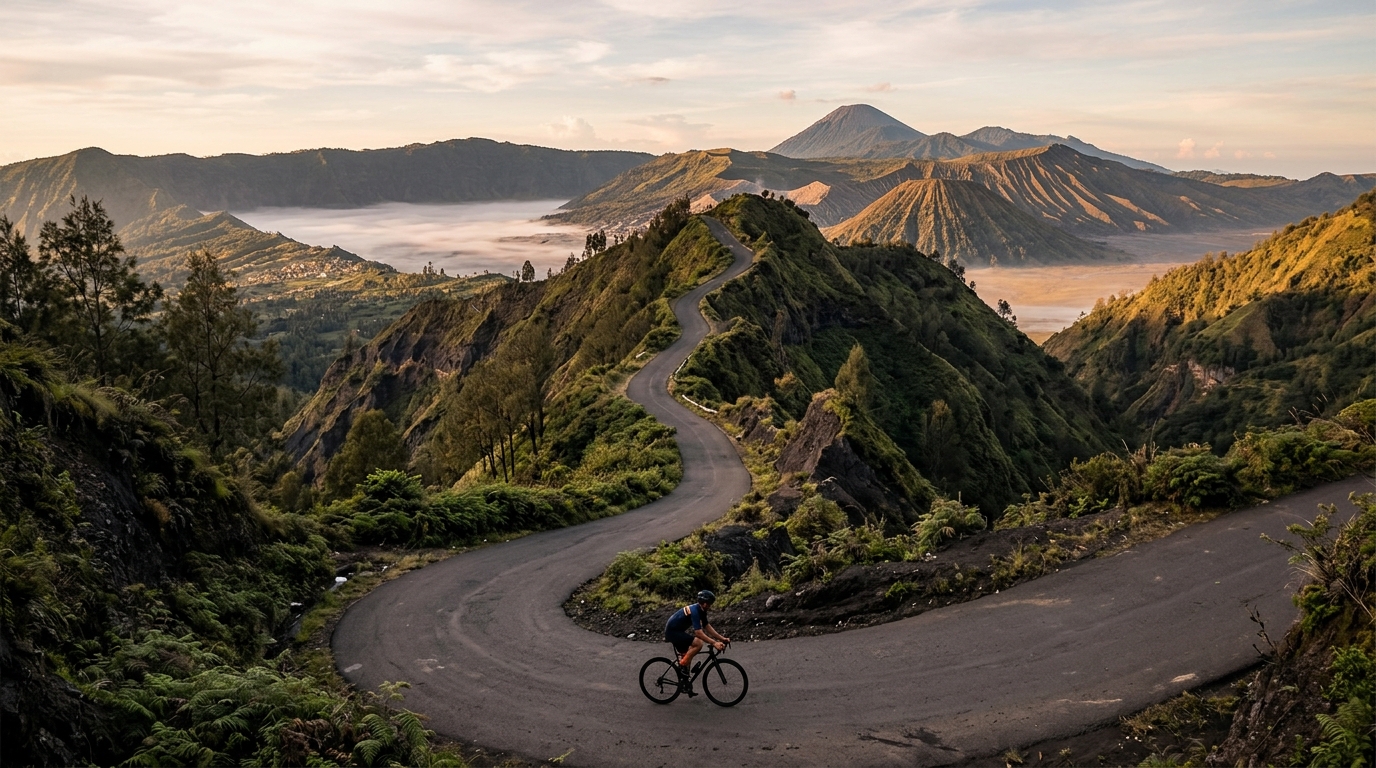
Bromo is the headline ascent. Set on one of the country's most recognisable volcanic landscapes, it is a climb built around a genuine summit objective, drawing riders toward the caldera country that has made the mountain famous. It is the kind of ascent where the effort and the reward are tightly linked: the higher you go, the more otherworldly the surroundings become.
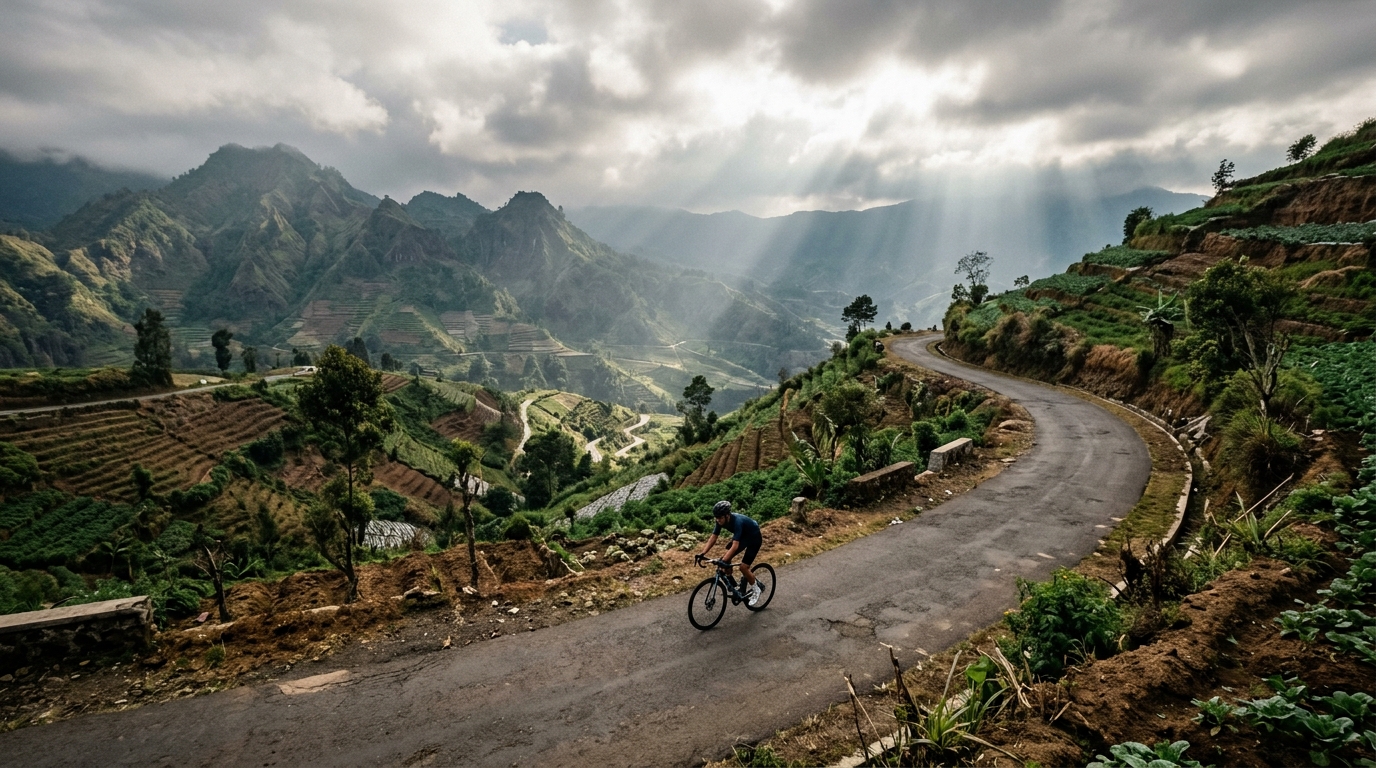
Dieng is the second catalogued climb, a high-plateau ride that carries you into elevated volcanic terrain. Where Bromo is about the pull toward a single dramatic summit, Dieng offers the experience of climbing up onto a raised, cool tableland — a different flavour of the same volcanic geography.
Between them, these two climbs cover the essential Indonesian climbing experience: the hors catégorie difficulty at the top end, and the gradual gain in altitude that lifts you well clear of the coastal heat.
When to Ride
Timing in Indonesia is a question of managing the tropics. The climate is equatorial, which means heat and humidity down low are constants rather than seasonal exceptions. The single biggest variable is rain: the archipelago swings between wetter and drier periods, and the drier stretches are far kinder to a rider trying to grind up a long volcanic flank.
Aim for drier conditions if you can, both for grip on the road and for the visibility that makes climbs like Bromo worthwhile — a summit shrouded in cloud gives back little of what you climbed for. Because the summits sit high, expect a real temperature drop as you ascend. What feels oppressive at the bottom can turn genuinely cold near 2,672 m, so plan for both ends of that range in a single ride.
Practical Notes
Pack for contrast. A climb that starts in tropical heat and finishes at high altitude asks you to carry layers you will not want at the base but will be grateful for at the top. Sun protection and generous hydration matter on the lower slopes; a windproof layer earns its place near the summit.
Respect the gradient. With an hors catégorie climb in the mix, gearing should favour spinning over grinding — a wide-range cassette will save your legs across sustained pitches. Fuel and water are worth carrying, since the upper reaches of a volcanic climb can be sparse on resupply.
Finally, treat these as destination climbs. With only two catalogued ascents, Indonesia is not a region you tick off casually between other rides; each of Bromo and Dieng deserves to be approached fresh, with the day planned around it.
Summary
Indonesia offers a compact but serious climbing catalogue: two volcanic ascents, one of them hors catégorie, reaching a high point of 2,672 m. Bromo delivers the iconic summit experience, while Dieng lifts you onto elevated plateau terrain. Both demand that you manage tropical heat at the bottom, thin cool air at the top, and the ever-present question of rain. Choose a drier window, gear for long sustained climbing, and pack for the full temperature range, and these two climbs repay the effort with some of the most distinctive volcanic riding anywhere.
Looking for full rides in Indonesia?
Routes in Indonesia