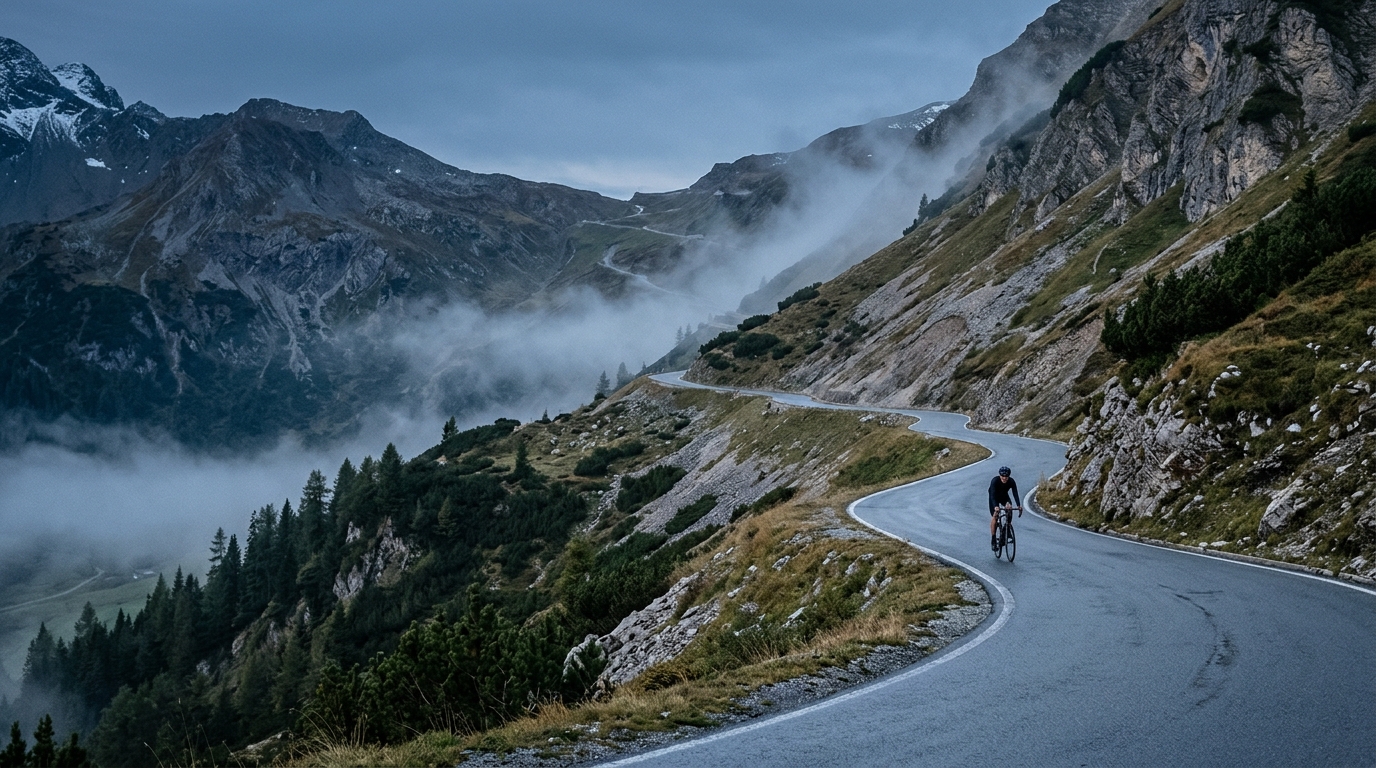
Arlberg Pass
A 12.2 km category 1 grind averaging 6.29%, climbing from 1031 m to 1800 m with pitches that flare to 11.27%.
- Length
- 12.2km
- Avg
- 6.3%
- Max
- 11.3%
- Summit
- 1,800m
- Ascent
- 748m
The climb
Gradient profile
Overview
The Arlberg Pass is a category 1 ascent that asks for steady, honest effort rather than heroics. Over 12.2 km the road lifts you from 1031 m at the base to a 1800 m summit, a net gain of 769 m. The average gradient of 6.29% sits in that demanding middle band: shallow enough that a strong rider can hold rhythm, steep enough that any overreach in the first few kilometres will be paid back with interest higher up. This is a climb of sustained tempo, punctuated by a maximum pitch of 11.27% that keeps you honest.
How the Gradient Unfolds
At 6.29% average across 12.2 km, the Arlberg is remarkably even in character, but the numbers hide a bit of texture. The gap between the 6.29% average and the 11.27% maximum tells you there are ramps roughly five points steeper than the mean — short bites where the road tilts up and forces a gear change. The total ascent of 748 m is marginally less than the 769 m net gain, which means the profile is almost purely uphill: there are effectively no false flats or descents to recover on. What you climb, you keep. Expect long, load-bearing stretches near the average, broken by the occasional lurch toward that 11.27% ceiling.
Pacing Notes
The key to the Arlberg is discipline in the opening kilometres. Because the grade rarely relents, a rider who starts above threshold will fade badly across the back half. Aim to settle just below your FTP on the sustained sections, reserving headroom for the steeper ramps toward 11.27% where power naturally spikes. Treat the 6.29% average as your baseline effort and let the pitches come to you rather than chasing them.
If you don't already know your threshold, work it out before you commit to this climb — a well-judged target turns 12.2 km of climbing from a survival exercise into a controlled effort. Use the FTP estimator to set a realistic ceiling, then ride 5-10% under it on the flatter tempo sections so you have something left when the road bites.
Gearing
For a climb averaging 6.29% with ramps to 11.27%, gearing is about protecting your cadence on the steep bites, not just surviving the average. A compact 34-tooth inner chainring is the sensible foundation. Paired with a 34×32, most fit riders will spin the sustained sections comfortably and only grind briefly on the max pitches. If you're carrying fatigue, riding at altitude near the 1800 m summit, or simply prefer to sit and spin, step up to a 34×34 — the extra sprocket keeps your cadence alive on the 11.27% sections and spares your knees over the full 12.2 km. Either way, favour the easier option; you rarely regret spare gears on a climb this long.
Summary
The Arlberg Pass is a fair, sustained category 1 climb: 12.2 km of consistent 6.29% gradient that rewards patience and even pacing over aggression. Set your effort below threshold, keep a compact gear in reserve for the 11.27% ramps, and you'll crest the 1800 m summit with something left in the tank.
Length: 12.2 km
Average gradient: 6.29%
Max gradient: 11.27%
Start: 1031 m
Summit: 1800 m
Net gain: 769 m
Total ascent: 748 m
Category: 1