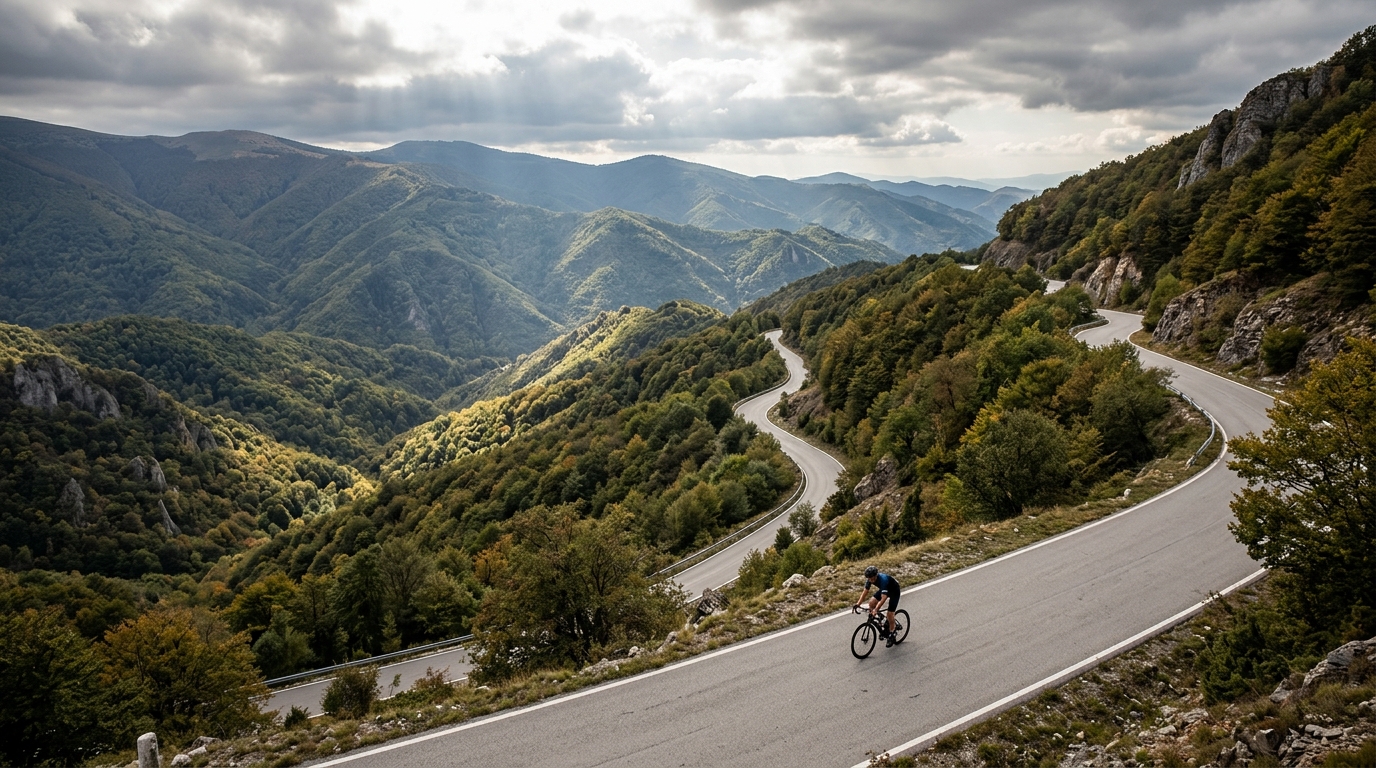
Shipka Pass
A practical pacing and gearing guide to the Shipka Pass cycling climb, a long category 2 ascent with a modest average but sharp ramps.
- Length
- 24.7km
- Avg
- 3.7%
- Max
- 14.6%
- Summit
- 1,227m
- Ascent
- 895m
The climb
Gradient profile
Shipka Pass cycling climb profile
Shipka Pass is a category 2 climb that asks for patience more than raw violence. On paper, the key number is the length: 24.7 km from a start elevation of 315 m to a summit elevation of 1227 m. That gives the climb its main tactical shape. It is not a short effort where you can cover mistakes with momentum. It is a long aerobic drag where small pacing errors early can become expensive late.
The average gradient is 3.69%, which makes the climb look controlled, but that number needs context. A climb with a maximum gradient of 14.62% is not simply a steady false flat. The average tells you there is plenty of rideable terrain across the full length, while the maximum tells you there are sharp sections capable of forcing a real change in cadence, gear choice, and power output.
How the gradient unfolds
The supplied profile does not break the climb into named sectors, so the safest reading is to treat Shipka Pass as a long climb with a generally moderate overall grade and intermittent steep pitches. The difference between the 3.69% average and the 14.62% maximum is the important clue. If you pace it only by the average, the steepest ramps will feel like interruptions. If you pace it as a 24.7 km climb with harder moments embedded inside it, the profile becomes much more manageable.
The vertical gain is listed as 912 m net from bottom to top, with total ascent listed at 895 m. Either way, the ride is defined by a long accumulation of elevation rather than one decisive wall. That means fatigue builds gradually. The challenge is not only getting over the steepest pitch, but arriving there without having already spent too much above threshold.
Pacing and gearing notes
For pacing, Shipka Pass rewards restraint. Settle below your sustainable climbing effort early, especially if riding by /glossary/ftp or perceived exertion. The average gradient can tempt you into riding too hard because the road may often feel manageable. The risk is that the 14.62% maximum gradient forces a power spike later, when glycogen and cadence control are already under pressure.
Gearing should be chosen for the steepest number, not the average. A setup that feels comfortable at 3.69% may be too heavy when the road kicks up. Prioritise a low enough climbing gear to keep cadence from collapsing on the hardest ramps. On a long climb like this, saving the legs during the steep sections is usually faster than muscling through them and paying for it over the remaining kilometres.
The practical strategy is simple: ride the early and moderate gradients smoothly, keep surges short, and avoid turning every steep pitch into a threshold test. Shipka Pass is long enough that efficiency matters more than bravado.