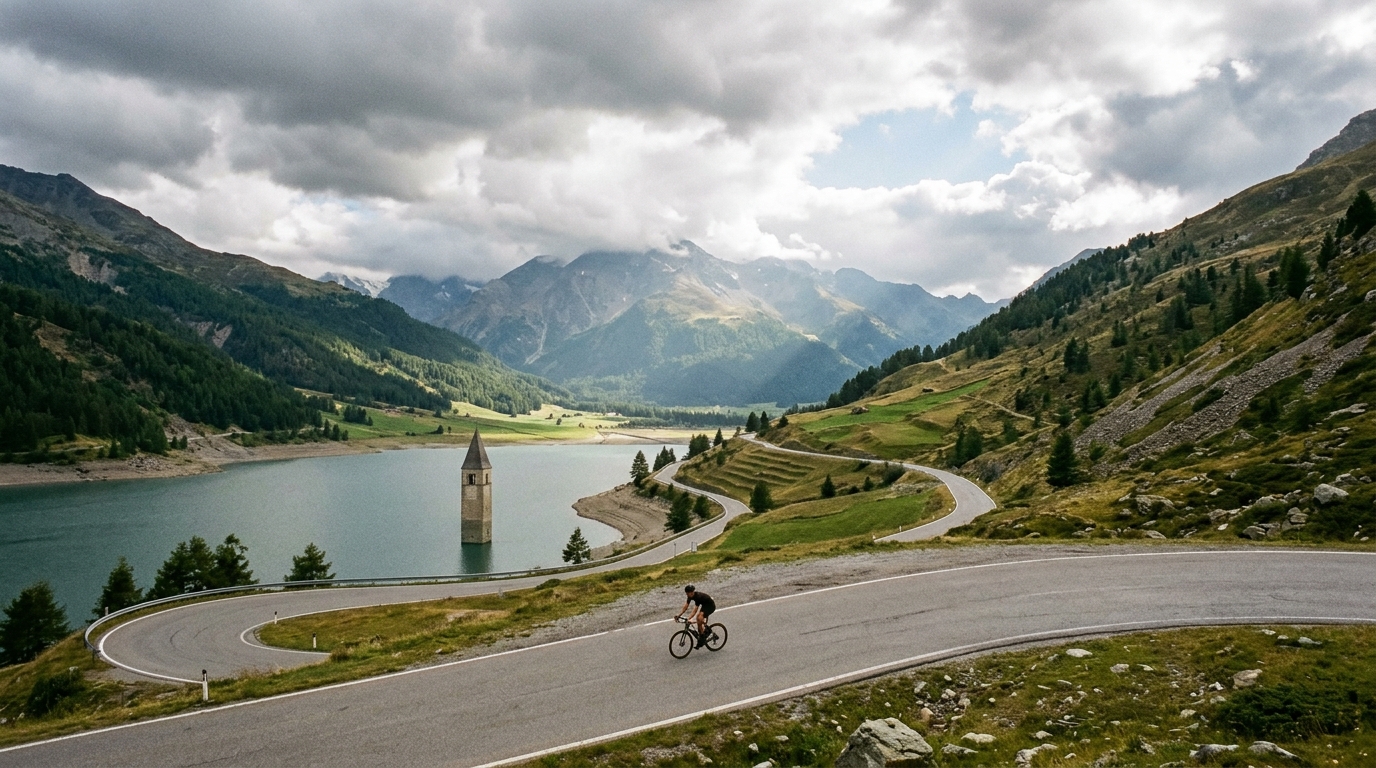
Reschen Pass
A practical pacing and gearing guide to the Reschen Pass cycling climb, a steady category 2 ascent in Italy.
- Length
- 5.9km
- Avg
- 6.4%
- Max
- 7.5%
- Summit
- 1,418m
- Ascent
- 348m
The climb
Gradient profile
Reschen Pass cycling climb profile
The Reschen Pass is a category 2 climb in Italy that asks for control more than heroics. At 5.9 km, with a start elevation of 1042 m and summit elevation of 1418 m, it gains 376 m net from bottom to top. The average gradient is 6.43%, and the maximum gradient is 7.5%.
That relationship between the average and maximum gradient is the important part. A climb averaging 6.43% but topping out at only 7.5% is not defined by violent ramps. It is defined by pressure. The gradient range is narrow enough that the effort should feel continuous, with little statistical evidence for either major relief or a wall that forces a complete change in rhythm.
How the gradient unfolds
From the bottom, the safest assumption is that the Reschen Pass settles quickly into its working gradient. The numbers point to a climb where you are rarely far from the average. That makes it easier to pace than a climb with repeated spikes, but it also removes the obvious places to recover.
The middle of the climb is where riders can get into trouble. A 6.43% average does not sound extreme, but over 5.9 km it is long enough to punish small overextensions. Because the maximum gradient is only 7.5%, the climb is unlikely to demand repeated out-of-saddle accelerations. Instead, it rewards riders who can sit, hold torque smoothly, and keep the effort just below the point where breathing starts to outrun the legs.
Near the summit, the same logic applies. There is no indication in the available profile data of a final kicker beyond 7.5%, so the finish should be paced as a continuation of the climb rather than a separate problem. If you still have room to lift the effort late, it is probably because you managed the first half correctly.
Pacing and gearing notes
Treat the Reschen Pass as a sustained aerobic-to-threshold climb, not a punchy test. If riding by power, keep the early effort disciplined against your /glossary/ftp rather than chasing speed. The relatively steady gradient makes it tempting to lock into a strong rhythm immediately, but that is exactly where riders often spend too much too soon.
Gearing should support cadence under constant load. You do not need a panic gear for extreme ramps based on the stated maximum gradient, but you do need enough range to stay seated and smooth when the road holds near the average for several kilometers. If your lowest gear only feels comfortable on short rises, it may feel restrictive here.
The clean way to ride it is simple: start contained, settle into a sustainable gear, avoid big surges, and use the final section only after the climb has confirmed you have the legs. On a climb this steady, pacing errors are not dramatic at first. They just compound.