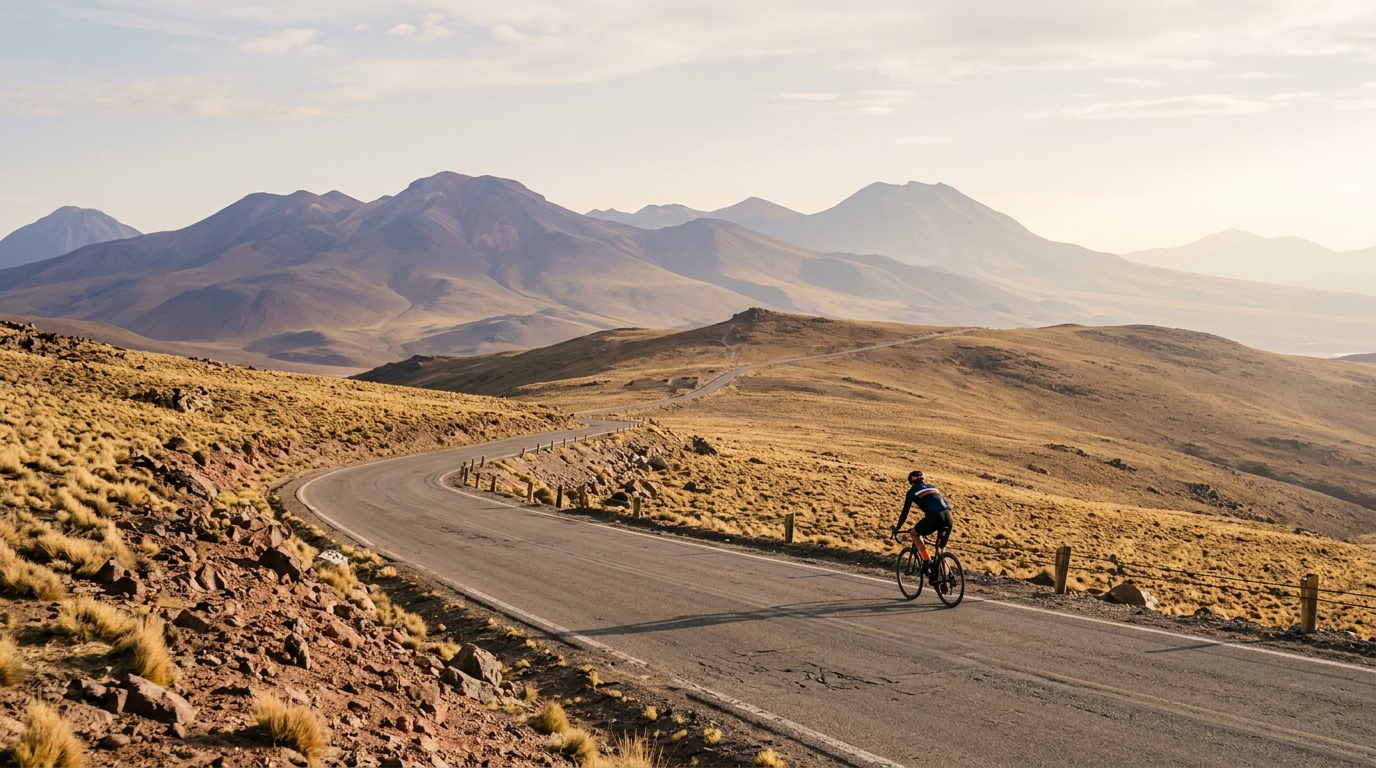
Paso de Jama
A short, high-altitude Category 4 climb with steady gradients and limited steepness, where pacing discipline matters more than raw torque.
- Length
- 4.6km
- Avg
- 4.5%
- Max
- 5.6%
- Summit
- 4,305m
- Ascent
- 191m
The climb
Gradient profile
Paso de Jama cycling climb profile
Paso de Jama is a short Category 4 climb, but the headline number does not fully capture the ride. On paper, 4.6 km at 4.48% is controlled rather than intimidating. The steepest reported gradient is 5.59%, which tells you this is not a climb defined by violent ramps or gear-grinding walls. The difficulty comes from where it sits: the road starts at 4097 m and tops out at 4305 m.
That changes the way the climb should be ridden. At this elevation, the gradient is modest, but the cost of going slightly too hard is higher. A rider who treats the opening kilometre like a normal sub-5% rise can find the effort compounding quickly, not because the road suddenly becomes brutal, but because recovery at altitude is less forgiving.
Gradient and effort
The numbers point to a relatively even climb. With an average of 4.48% and a maximum of 5.59%, the road does not appear to have major spikes above its baseline gradient. That narrow spread matters tactically. Instead of needing repeated accelerations over steep pitches, the better approach is to lock into a sustainable tempo and avoid unnecessary surges.
The climb gains 208 m from start to summit, with the dataset also listing 191 m of total ascent. Either way, this is not a long vertical test. The main challenge is holding a clean aerobic effort from bottom to top while resisting the temptation to over-pace a climb that looks manageable on gradient alone.
Pacing and gearing notes
Ride Paso de Jama as a steady-state climb. If using power, anchor the effort below the point where breathing becomes ragged, especially in the first half. The gradient is shallow enough that it can invite pressure on the pedals, but the altitude makes that a bad trade if it pushes you above a sustainable ceiling. For reference, pacing around your known /glossary/ftp should be conservative rather than optimistic here.
Gearing should not need to be extreme for the slope itself. A 5.59% maximum gradient is not steep, but an easier gear is still useful because it lets you keep the effort smooth rather than forcing low-cadence torque. The practical goal is to stay seated, keep the drivetrain turning freely, and avoid muscular spikes that are harder to clear at 4097 m to 4305 m.
How to ride it well
The key is restraint. Let the first minutes feel slightly too easy, then allow the climb to settle into a controlled rhythm. Because there is no evidence in the profile of a decisive steep section, there is little upside in saving for a final wall. Instead, the fastest ride is likely the one with the least variation: steady pressure, calm breathing, and no wasted accelerations.