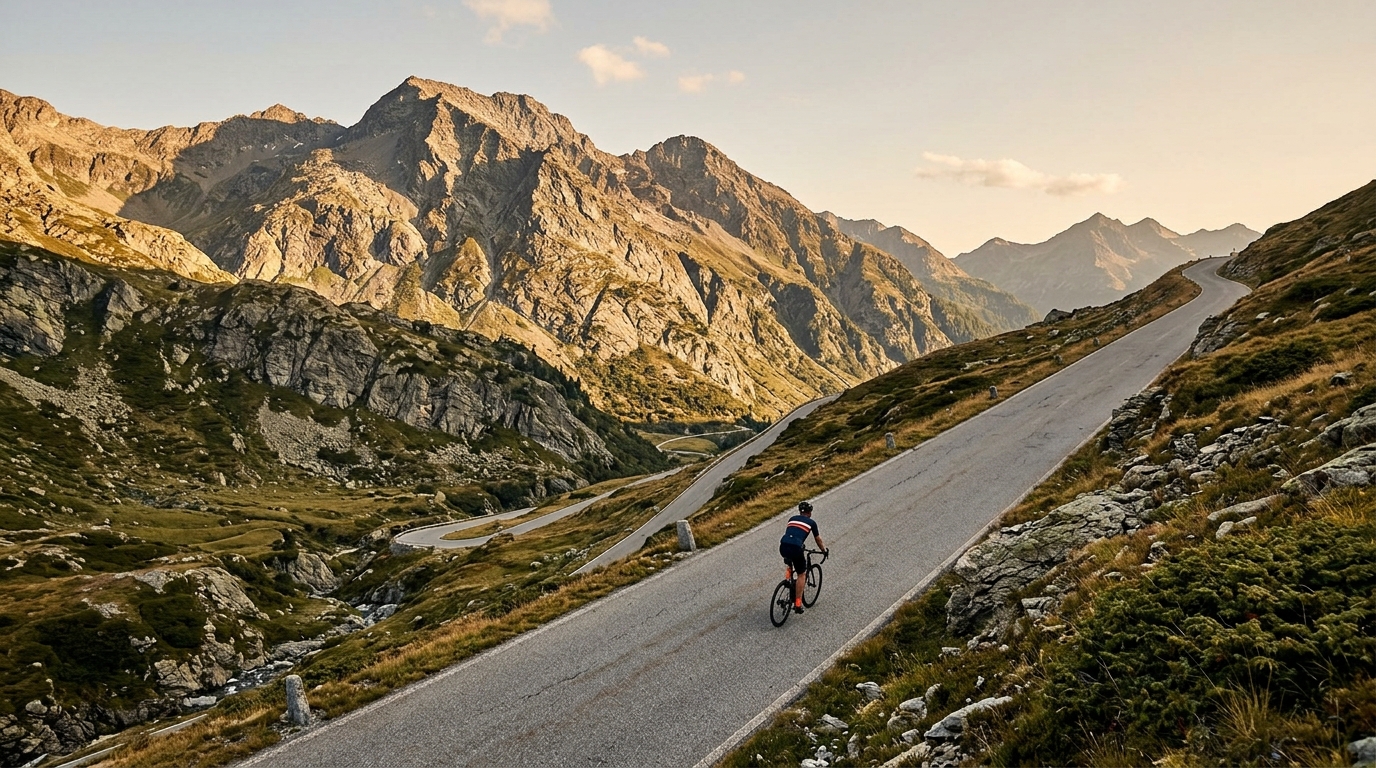
Guriner Furggu
A sustained HC Swiss climb: 19.4 km at 8.3%, rising from 404 m to 2011 m with pitches reaching 19.5%.
- Length
- 19.4km
- Avg
- 8.3%
- Max
- 19.5%
- Summit
- 2,011m
- Ascent
- 1,591m
The climb
Gradient profile
Guriner Furggu cycling climb profile
Guriner Furggu is an HC climb in Switzerland that demands patience more than aggression. On paper, the key number is not just the 19.4 km length or the 8.3% average gradient. It is the combination of the two. Holding that gradient for that distance means this is not a climb where a rider can bluff the opening, recover in the middle, and still finish cleanly. The cost compounds.
The road starts at 404 m and finishes at 2011 m, with a listed net elevation gain of 1607 m. That tells you the basic tactical problem: almost all of the ride is vertical work. Even before considering the 19.5% maximum gradient, the average alone puts the climb firmly into sustained threshold-and-below territory for most riders.
How the gradient rides
The available profile data does not break Guriner Furggu into lower, middle, and upper sectors, so the safest reading is to treat the entire climb as consistently severe. An 8.3% average across 19.4 km leaves little room for long, meaningful recovery. If there are easier sections, they are likely to be absorbed by the harder ramps rather than resetting the effort.
The 19.5% maximum gradient is the detail that should shape how you ride it. A climb can average 8.3% and still feel manageable if the grade is smooth. Add ramps near 20%, and the effort becomes much more stochastic. Those sections force torque, raise breathing rate, and punish riders who have already drifted above sustainable power.
That is why the climb should be paced from the bottom as an endurance problem first and a gradient problem second. The summit elevation of 2011 m also matters because the final part of the climb comes after a large vertical gain, when fatigue is already high. Even without assuming anything about altitude response, reaching that height after starting at 404 m means the finish arrives deep into the effort, not as a short final kick.
Pacing and gearing notes
Start below your target climbing power, not at it. If you know your /glossary/ftp, the opening should feel controlled enough that the steepest ramps can be covered without repeated surges above threshold. Riders who pace by feel should avoid chasing speed early, because an 8.3% average makes speed a poor guide to effort.
Gearing should be chosen for the 19.5% maximum gradient, not the average. If your easiest gear only works at 8% when fresh, it will not be low enough once fatigue meets the steepest ramps. The goal is to keep cadence from collapsing, especially late in the climb when force production becomes the limiter.
Practical approach:
- Ride the first section conservatively, assuming there is no free recovery later.
- Shift early before the steepest pitches rather than grinding into them.
- Keep seated as much as possible to control traction and muscular load.
- Use any flatter-feeling moments to restore breathing, not to accelerate.
- Save a genuine margin for the final kilometres because the cumulative elevation gain is the real difficulty.
Guriner Furggu is the kind of climb where the best ride is often the least dramatic one. Settle into a sustainable rhythm, respect the maximum gradient, and let the numbers dictate restraint.